
Meta Business Agent on WhatsApp in India: What SMEs Should Automate First
A practical guide for Indian SMEs to audit WhatsApp enquiries, automate stable answers, protect customer data and add CRM or ERP connections only when the operating need is proven.

Share this article
Browse all insightsFor many small businesses in India, WhatsApp already carries product questions, catalogue requests, dealer enquiries and delivery follow-ups. Meta Business Agent can help select eligible businesses answer some of those conversations, but the safest first use is deliberately narrow: automate stable information, keep judgement with people and connect internal systems only after the use case is proven.
A distributor receives, “Price for 100 pieces?” A manufacturer receives, “Can you send the catalogue?” An FMCG company receives, “Where is my nearest distributor?” A service company receives, “Are you open tomorrow?” Most of these messages are easy to answer. The difficulty is that somebody still has to answer them—throughout the day, after office hours and sometimes across several employees.
In May 2026, Meta launched the feature in India as Business AI on WhatsApp. Current WhatsApp documentation calls it Meta Business Agent, and the WhatsApp Business app may show an “AI agent” control. Meta says select eligible businesses can configure it with business information so it can answer questions, recommend products, capture leads and support sales conversations. A person can take over when necessary.
The important SME question is therefore not “How many conversations can AI handle?” It is “Which conversations have answers we can safely define, maintain and review?”
Cover image: AI-generated editorial illustration. The people, messages and business shown are fictional, contain no real customer data and do not represent a GreyBath client implementation.
01 · Start with the product that exists
Understand what Meta launched—and what it does not automatically provide
Meta’s May 2026 India announcement described Business AI for eligible small and medium-sized businesses using the WhatsApp Business app. Meta presented it as a way to configure AI assistance without coding or third-party software for common questions, business and product information, recommendations, lead capture, appointment booking and sales conversations.
The current WhatsApp setup guidance uses the name Meta Business Agent and says availability is limited to select businesses and countries. The name and controls visible in an account can therefore differ from the launch announcement.
Use one decision principle
Automate predictable conversations, not business judgement. Business hours can come from a controlled source. A negotiated rate for 5,000 units may depend on quantity, freight, geography, payment terms, customer history and approval. An order-status answer may exist, but only in a live dispatch or ERP record.
The built-in agent is a useful starting point; it is not the same as giving WhatsApp secure access to every business system. Check whether the app-level feature solves the basic requirement before evaluating a chatbot vendor, the WhatsApp Business Platform or a custom integration.
02 · Know what changes for customers and staff
Review privacy, data use and product side effects before enabling the agent
An AI-enabled business conversation is not operationally identical to an ordinary staff-managed chat. WhatsApp’s customer-chat and data-use guidance says customers receive a notice when they first chat with a business using Meta Business Agent. It also explains that Meta can receive information from AI-enabled chats to generate business responses and improve Meta AI. AI responses can be inaccurate or inappropriate.
Review the in-product disclosure and current terms before activation. Decide what the business will tell customers, what information may enter an AI-enabled conversation, how corrections and complaints will be handled, and how data-access, download, retention or deletion requests will reach the appropriate person. Pausing AI replies and removing the agent are not necessarily the same control; verify the current behaviour shown in the account.
Current WhatsApp guidance also warns that enabling the agent can affect features such as linked devices, broadcasts, disappearing messages and greeting or away messages. Record the present setup before activation, test the actual account and maintain a rollback plan. Do not discover after launch that a staff device or an existing message workflow has changed unexpectedly.
Use a safe message-audit method
- Keep the working sample in a controlled business location, not a personal spreadsheet or messaging account.
- Remove names, phone numbers, order references and other identifiers when the analysis does not need them.
- Do not place passwords, OTPs, payment credentials, contracts, internal margins, health or safety records, or unrestricted customer files into the agent.
- Collect only the fields required for the next business action.
- For regulated or high-risk data, obtain suitable privacy, legal and security review for the actual use case.
03 · Begin with evidence from your own inbox
Audit the last 100 customer questions before configuring answers
Take a practical sample of 50, 100 or 200 recent genuine customer questions. The objective is not to copy entire conversations into a presentation. It is to learn which questions recur, which answers are controlled and where current information or judgement is required.
Conversation auditClassify the question before choosing the technology
| Query type | Example | Likely dependency |
|---|---|---|
| Business information | “Where is your office?” | Approved profile information |
| Product information | “Do you have this size?” | Catalogue or live stock, depending on wording |
| Catalogue request | “Send the latest catalogue.” | Current approved document |
| Commercial enquiry | “Rate for 500 pieces?” | Pricing policy and possibly approval |
| Dealer enquiry | “How can I become a distributor?” | Standard process, followed by human review |
| Delivery enquiry | “When will my material reach?” | Order and logistics data |
| Accounts enquiry | “Send my invoice copy.” | Identity, authorisation and billing record |
| Complaint | “Material arrived damaged.” | Evidence, policy and judgement |
| New lead | “We need 2,000 units monthly.” | Qualification and named sales owner |
When the same question keeps returning, ask two questions. Can the business publish a dependable answer? Is the repeated question exposing a deeper process problem? “Our team will check and revert” may reduce typing, but it does not solve missing dispatch visibility or make invoices easier for customers to obtain.

AI-generated GreyBath editorial image. The people and business are fictitious; no GreyBath client, real customer message or personal data is shown.
Conversation audit workflowSwipe sideways to follow all five steps
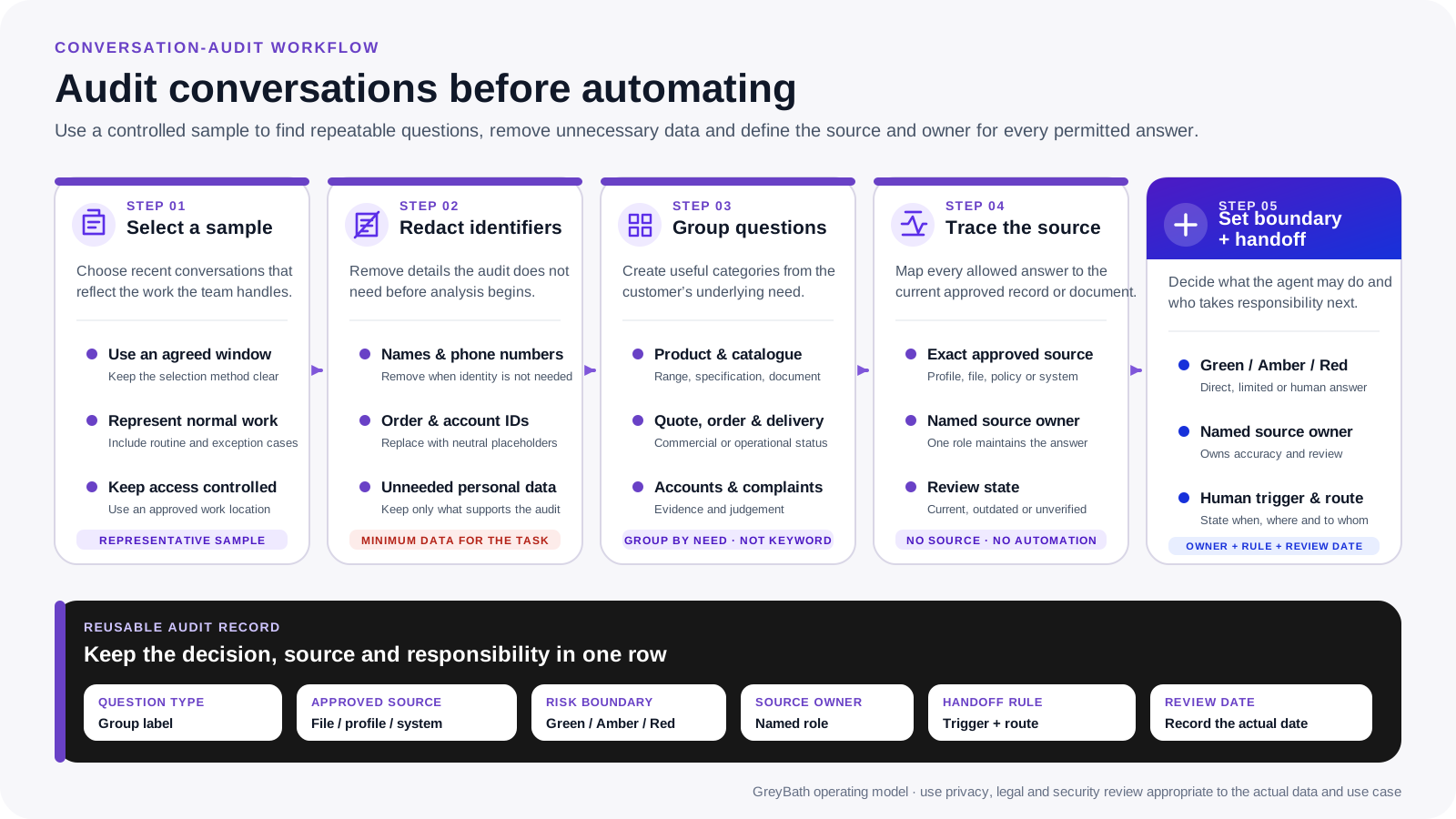
Original GreyBath educational diagram. It illustrates a suggested review process, not an automated assessment or an extract of real customer data.
04 · Define the boundary before the answers
Sort enquiries into Green, Amber and Red
Green: answer from approved, stable information
Suitable early candidates include office address, working hours, a public catalogue, standard product descriptions, published warranty terms, general service areas and a basic dealership-enquiry process. Even a Green answer needs an approved source, an owner and a review date.
Amber: help only when the current source is reliable
Stock, dispatch status, expected delivery, customer-specific prices, invoice balances and dealer credit limits may be automatable later. They are unsafe when the agent relies on an old catalogue, a stale export or an unverified customer identity. Static knowledge is not a substitute for live operational data.
Red: retain authorised human judgement
Negotiated pricing, credit approval, complaint compensation, contract commitments, large custom quotations, safety-critical advice and regulated professional advice should remain with the authorised person. AI may collect preliminary details or prepare a draft, but it should not make the commitment.
Automation boundarySwipe sideways to compare all three decision zones
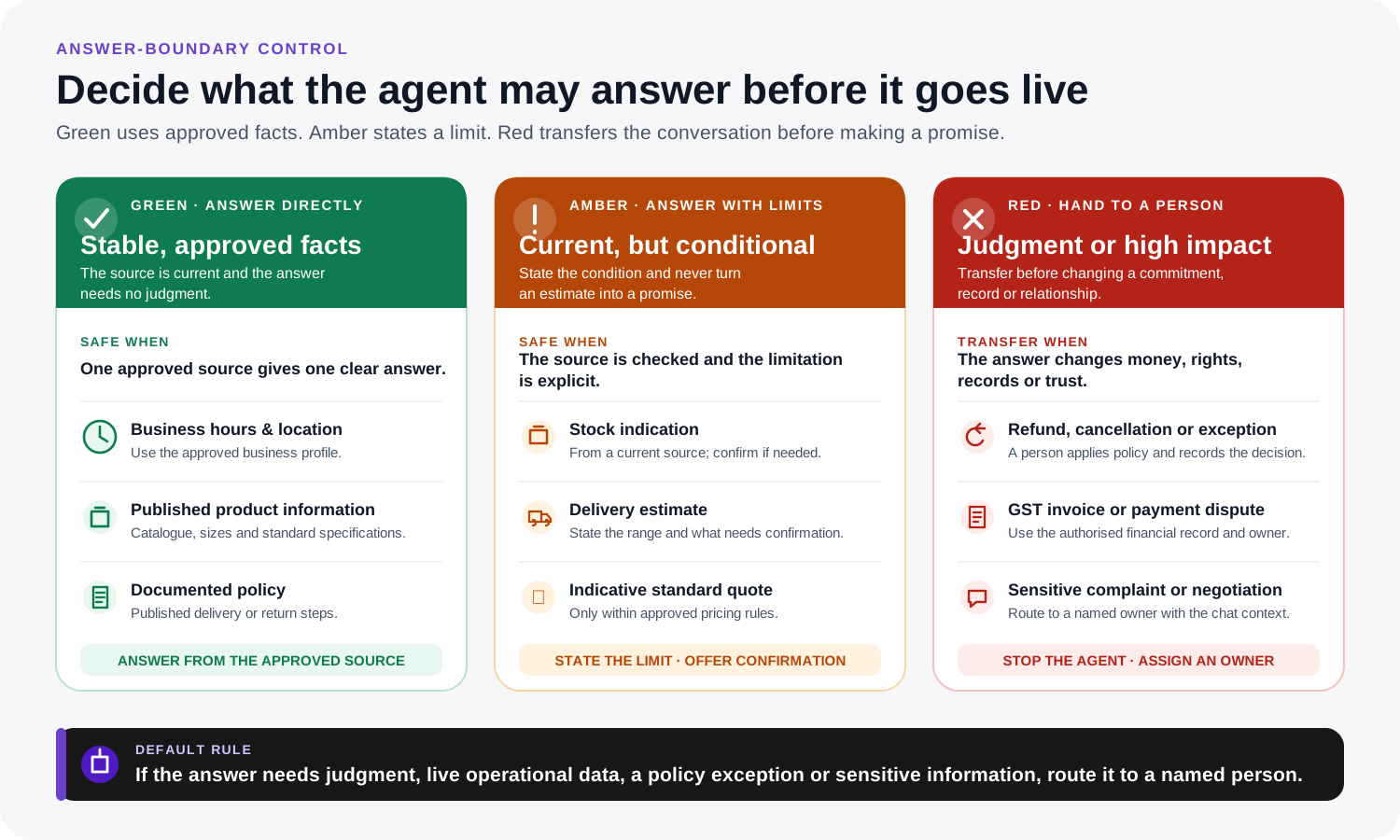
Original GreyBath educational diagram. It is a decision aid, not a claim that every live-data case can or should be integrated.
05 · Treat information maintenance as part of the system
Control the answer, source, owner and handover rule
Imagine a distributor approves the sentence “Standard delivery is three working days.” Three months later it expands into a region where delivery takes five days, but nobody updates the source. The agent can function exactly as configured and still provide the wrong answer. That is a business-information control failure.
If the version available to your business permits websites, documents or other materials to inform the agent, do not add everything. An old price list, expired offer, previous return policy, distributor-only document or internal margin note can be both stale and inappropriate for customers.
Classify candidate material as approved customer-facing, internal reference, or expired/do not use. More documents do not automatically create better answers; smaller, approved and maintained sources are safer.
Answer-control registerKeep source, risk and handover decisions together
| Question | Approved answer or source | Classification | Owner | Last reviewed | Changes often? | AI allowed? | Handover rule |
|---|---|---|---|---|---|---|---|
| Working hours | Business profile | Public | Admin | Record actual date | Rarely | Yes | Transfer if customer needs an exception |
| Standard MOQ | Current sales policy | Customer-facing | Sales | Record actual date | Sometimes | Only after review | Transfer custom quantities |
| Current stock | Inventory system | Customer-specific/live | Operations | Live source | Constantly | Not from static content | Use authorised lookup or staff |
| Dealer discount | Sales approval | Restricted commercial | Sales | Per policy review | Customer-specific | No independent commitment | Always transfer to authorised sales owner |
| Product brochure | Current approved file | Public | Marketing | Record actual date | Periodically | Yes | Transfer specification questions |
| Dispatch status | Order/logistics record | Customer-specific/live | Operations | Live source | Constantly | Only after secure lookup | Transfer delay or exception |
06 · Make escalation a designed outcome
Define when a person takes over—and who owns the next action
A successful automation is not one that prevents human involvement. It is one that uses human time where judgement and responsibility add value. WhatsApp’s Meta Business Agent guidance describes business responses and agent behaviour, but the business must still define its own service rule.

AI-generated GreyBath editorial image. The people, workplace and enquiry are fictitious; no GreyBath client, real dispatch record or customer data is shown.
Human takeoverPair every trigger with an accountable team
| Situation | AI action | Internal owner | Service rule |
|---|---|---|---|
| Standard FAQ or approved catalogue | Respond from approved source | Source owner monitors accuracy | Offer a person if the answer does not help |
| Serious purchase requirement | Collect only the required qualification fields | Sales | Assign the lead and state the response window |
| Dealer enquiry | Explain the standard process | Channel sales | Transfer eligibility or territory decisions |
| Order or dispatch exception | Avoid an unverified commitment | Operations | Confirm who will check and by when |
| Payment or invoice query | Do not expose records without authorisation | Accounts | Use an approved verification path |
| Complaint, damage or disputed price | Acknowledge and collect minimum initial evidence | Customer service or authorised sales owner | Do not promise compensation or a final rate |
| Agent cannot answer or customer asks for a person | Stop the loop and transfer | Named support queue | Give a realistic response window |
A safe fallback is specific: “I cannot verify that from the approved information. A member of Operations will review it by the next business day.” Avoid an endless loop in which the agent repeatedly asks the customer to rephrase the same problem.
Lead capture is useful only if the lead reaches an owner. Record the company, requirement, location, product or service and quantity only where those fields are necessary for the next action. The WhatsApp number may already be sufficient contact information; do not collect another field merely because a form can ask for it.
07 · Worked example
Apply the boundary to a hypothetical industrial distributor
Consider Metro Industrial Supplies Pvt Ltd, a fictional company—not a GreyBath client. It distributes industrial consumables to dealers and factories across Maharashtra, employs six salespeople and reviews 200 recent WhatsApp customer conversations.
Hypothetical message sampleClassify frequency without assuming automation success
| Query type | Conversations | First-phase treatment |
|---|---|---|
| Catalogue or product range | 46 | AI shares the approved current catalogue |
| Standard MOQ or supply area | 28 | AI answers only fixed approved rules |
| New quotation enquiries | 39 | AI captures minimum details; Sales decides the price |
| Current stock questions | 25 | Staff handles until an authorised live source exists |
| Existing order or dispatch | 32 | Operations handles customer-specific status |
| Dealer enquiries | 18 | AI explains the process; Channel Sales decides |
| Complaints or exceptions | 12 | Human-led, with optional initial detail capture |
| Total | 200 | Hypothetical sample—not a performance result |
Management does not conclude that a percentage of WhatsApp can be automated merely by adding the first two rows. It asks whether each answer has a dependable source. The first phase covers catalogue requests, business information, fixed MOQ rules and the standard dealer process. Quotation enquiries transfer to Sales; stock and dispatch remain with Operations; complaints remain human-led.
This is a sensible first deployment because the company automates what it understands and exposes the information gaps it still needs to fix.
08 · Limit the blast radius
Run one controlled pilot and measure useful outcomes
- Select one stable enquiry class, such as public product questions, dealer-process enquiries or after-hours FAQs.
- Approve the small set of source answers and record an owner and review date.
- Define transfer triggers, destination owner and response window.
- Test normal, ambiguous, misspelled, mixed-language, outdated and adversarial questions.
- Run the pilot for a limited audience or period available within the product controls.
- Review all exceptions plus a defined random sample of conversations that appeared successful.
- Log corrections, source weaknesses and unresolved handovers.
- Make an explicit continue, revise or rollback decision.
Exception-only review is insufficient. A confident but incorrect reply may look successful unless somebody samples apparently completed conversations.
Pilot scorecardUse denominators and quality checks—not reply volume
| Measure | Definition | Why it matters |
|---|---|---|
| Audited correct-resolution rate | Correct intended automated resolutions ÷ audited AI-handled conversations | Tests whether answers solved the configured question accurately |
| Human-takeover rate | AI-started conversations handed to staff ÷ AI-started conversations | Shows where people remain necessary; a high rate is not automatically bad |
| Lead completeness | Qualified leads with required fields ÷ qualified leads routed to Sales | Checks whether Sales received what it needs, not whether the AI asked many questions |
| Unresolved rate | Conversations unresolved inside the internal service window ÷ pilot conversations | Finds customers falling between AI and staff |
| Stale-answer incidents | Confirmed answers wrong because the approved source was outdated | Tests the maintenance process |
| Median time to human takeover | Median elapsed time from transfer trigger to staff ownership | Tests whether escalation actually reaches a person |
| Repeat-query frequency | Repeated enquiries caused by the same unresolved process issue | Shows where the underlying business process needs improvement |
“AI replies sent” is an activity count, not a customer outcome. The goal is to reduce avoidable work while improving accurate response and responsible follow-up.
09 · Add technology only when the process requires it
Move from the app to structured records and integrations in stages
Stage 1: stay inside the WhatsApp Business app
Use the simpler setup when message volume is manageable, most questions have approved stable answers, one or two employees can handle transfers and the agent does not need live CRM or ERP data. This is the benefit of the built-in starting point.
Stage 2: add a controlled lead sheet or existing CRM
If the agent begins producing enough serious enquiries that staff cannot see which are new, assigned, contacted or awaiting follow-up, use a structured shared register or configure the CRM already in use. This still does not automatically justify custom software. The same reconciliation discipline used to check whether website enquiries reached the CRM and a sales owner can be adapted to WhatsApp leads.
Stage 3: design a connected workflow
The requirement changes when customers expect live answers such as “Has order SO-1842 been dispatched?”, “What is my outstanding balance?” or “How many units are available today?” Those answers may live in ERP, inventory, billing, logistics or service systems.
Do not assume the built-in app feature exposes an ERP connector. Connected workflows may require the WhatsApp Business Platform or the separate capabilities described in Meta’s Meta Business Agent platform announcement, supported APIs, separate permissions and a different commercial setup. Meta has also announced app and platform developments, but current eligibility and implementation details must be checked for the actual account.
Operating-model ladderSwipe sideways to follow the four stages
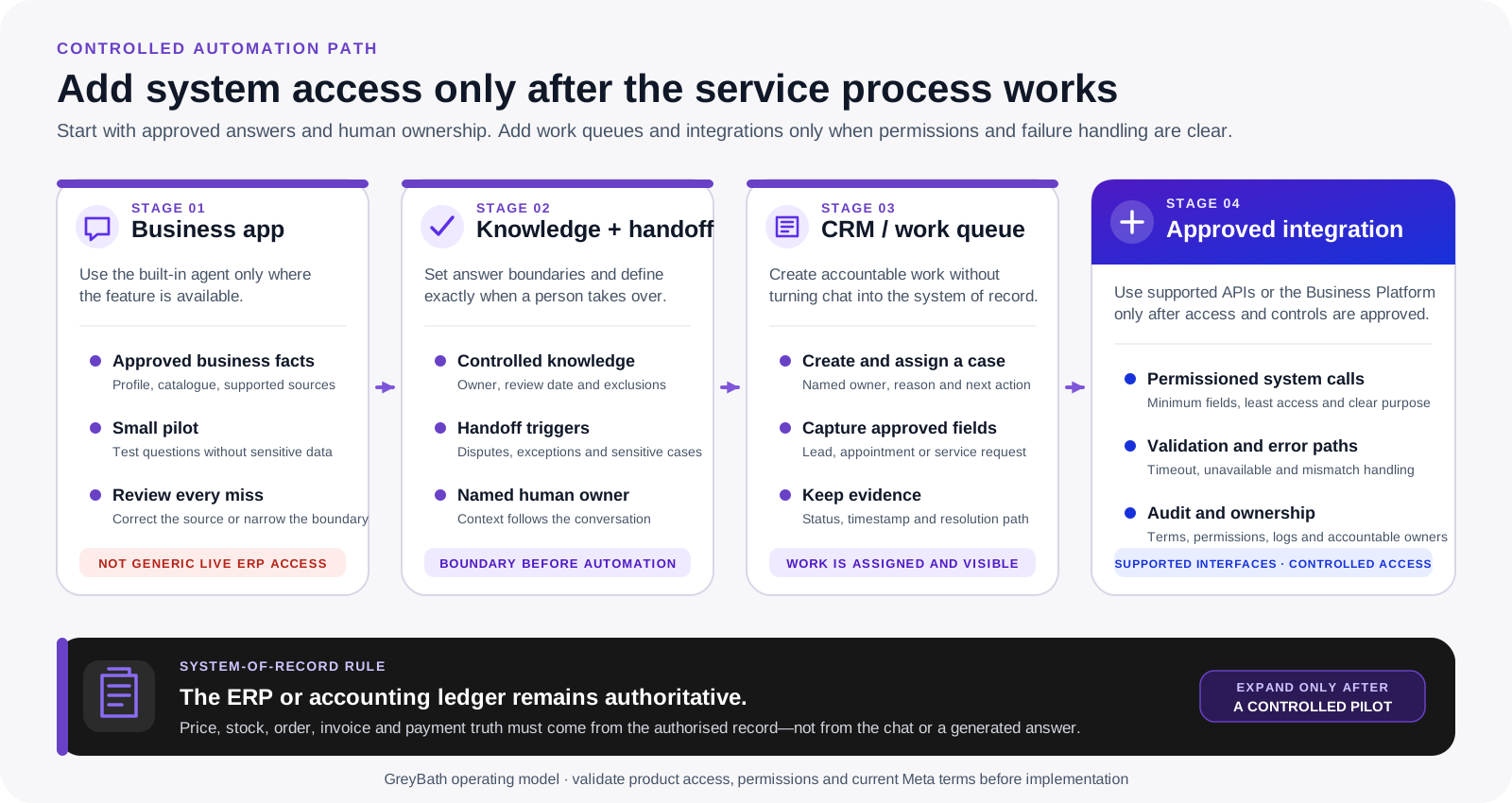
Original GreyBath educational diagram. Connected-system availability depends on supported interfaces, permissions, account eligibility, security controls and the systems already in use.
10 · Make customer-specific access explicit
Do not expose a complete ERP—or trust a phone number as universal authentication
Public business information and customer-specific information require different controls. Before returning an order status, invoice, balance, negotiated price or dealer credit information, establish that the requester is entitled to receive it. A visible WhatsApp number alone may not provide enough assurance for the information involved.
A controlled lookup might use an authenticated portal link, an OTP sent through an approved path to a registered contact, a verified customer-and-account match or a short-lived signed link. The appropriate method depends on the data, threat model and existing business systems.
Minimum controls for a connected workflow
- Authenticate the requester and enforce authorisation on the server for every lookup.
- Expose only allowlisted fields needed for the approved response.
- Use least-privilege credentials, audit logs, rate limits and a documented revocation process.
- Do not trust a model-supplied customer, order or invoice identifier without server-side validation.
- Do not permit unrestricted writes, refunds, credit changes or commercial commitments.
- Keep public FAQs separate from customer-specific tools and data.
- Route failures safely to a named owner instead of guessing.
- Maintain an off switch, rollback procedure and incident contact.
For example, an authorised dispatch lookup may require only:
Verified customer → authorised order → current dispatch field → approved response.
It does not require all customers, all orders, margins, internal notes or unrestricted ERP access. Review any platform implementation against the current WhatsApp Business Solution Terms and the organisation’s applicable privacy, security and contractual obligations.
11 · Test the cases that create confident mistakes
Language support, pricing and payments need separate verification
Test the phrases customers actually use
Meta’s May India launch announcement referred to native Indian-language support. Current WhatsApp Help Center guidance says not all languages are supported and that language behaviour depends on the business phone number. Test the exact languages and code-mixed phrases used in the account, including product nicknames, regional expressions, abbreviations and misspellings. General language support does not guarantee correct interpretation of an internal product code.
Do not load one unrestricted commercial rate sheet
A fixed public retail price is different from dealer, distributor, project, quantity-break, freight-inclusive, cash or credit pricing. If price depends on customer identity or approval, route the enquiry to Sales or query an authorised price record only after the requester and entitlement have been established.
Treat UPI support as announced until it is verified in the account
Meta’s May 2026 announcement said it planned to let Business AI facilitate UPI payments inside WhatsApp chats and described the capability as “starting soon.” Do not promise or design a required operating process around it merely because it was announced. Confirm the current feature, eligibility, terms and payment controls for the specific business account and use case.
12 · Complete this before buying another chatbot
Use a reusable WhatsApp AI readiness sheet
| Question | Business answer |
|---|---|
| What are our ten most common WhatsApp enquiries? | Record from a privacy-safe message sample |
| Which have fixed, approved answers? | List the exact source and owner |
| Which depend on current system data? | Name the authoritative system |
| Which require commercial or professional judgement? | Name the authorised person |
| Which documents can customers safely receive? | Classify each current file |
| Which information is already outdated? | Correct it before configuration |
| Which conversations must transfer to a person? | Define triggers and fallback text |
| Who receives each transferred enquiry? | Assign one owner and service window |
| Which customer-specific data requires stronger verification? | Define identity and authorisation controls |
| How will incorrect answers be reported and corrected? | Define the log, source owner and rollback route |
| Which metrics and random samples will be reviewed? | Record the denominator, cadence and reviewer |
| What product or staff workflows could activation affect? | Check linked devices, greetings, away messages, broadcasts and disappearing messages |
If the business cannot complete this sheet, it is not ready to automate the conversation. AI does not create a missing policy. If five employees give five different answers to the same question, establish the business rule first.
Optional implementation support
Connect a proven conversation to the right operating system
GreyBath offers ERP, CRM and workflow automation and API-driven web applications and integrations for suitable business processes. A WhatsApp project becomes relevant when a working conversation needs controlled lead assignment, order-status lookup, service-ticket creation, dealer onboarding, alerts or management reporting.
The first step is still diagnostic: map one enquiry class to its approved source, identity requirement, owner, handover rule and measurable outcome. Existing app controls, a shared register or the current CRM may remain sufficient. Custom implementation is justified only when repeated work, live data, multiple teams or access controls require it.
The built-in WhatsApp Business app agent and the WhatsApp Business Platform or Meta Business Agent Platform are not interchangeable. Any connection would depend on the relevant Meta product, eligibility, supported interfaces, permissions, security controls and the client’s existing systems. GreyBath does not need to be involved when the built-in feature already solves the requirement.
Final takeaway
Automate stable answers before connecting live systems
Meta Business Agent offers select eligible Indian SMEs a simpler starting point for AI-assisted customer conversations inside WhatsApp Business. The responsible sequence is: understand the questions, control the information, automate stable answers, define human handover, review failures and random samples, then connect systems only when the operating need is proven.
If the built-in feature and a disciplined human process solve the problem without new software, that is a good technology decision.
Research record
Official sources
Official Meta and WhatsApp material was reviewed on 5 October 2026. The product is evolving; availability, naming, language support, data treatment, settings, payment features and platform interfaces should be checked again before activation.
- Meta: Introducing Business AI on WhatsApp for small businesses in IndiaMay 2026 India launch, eligible-business positioning, announced capabilities, no-code setup, human takeover and announced UPI direction.
- WhatsApp Help Center: Set up and manage Meta Business AgentCurrent product naming, select-account availability, controls and language qualifications.
- WhatsApp Help Center: Customer chats and data use with Meta Business AgentCustomer disclosure, data-use explanation, accuracy cautions and operational effects.
- WhatsApp Help Center: Business responses and Meta Business Agent behaviourAgent response and business-intervention context.
- Meta: Meta Business AgentSeparate platform direction and connected business-system context.
- WhatsApp Business PlatformOfficial platform overview for business messaging beyond the app-level starting point.
- Meta: New WhatsApp business tools announced in IndiaApp and platform product context; current account eligibility still requires verification.
- WhatsApp Business Solution TermsCurrent legal terms to review for an applicable business solution.
Keep reading
More practical thinking from GreyBath across design, engineering and growth.
All articles