
FMCG SMEs: How to Prepare Your Packaging for 2D Barcodes Before the 2027 Retail Shift
A practical FMCG SME guide to GTIN cleanup, GS1 Digital Link, dual marking, variable data, print testing and retail readiness for the 2027 POS ambition.
Share this article
Browse all insightsIf an FMCG pack already carries an EAN barcode, a printer, retailer or software provider may soon ask whether the brand is ready for 2D barcodes. Adding any QR code beside the existing symbol is not enough. The useful preparation work starts with product identity, data ownership, printing and trading-partner readiness.
For a small or medium-sized brand, this does not have to become an immediate ERP replacement or a catalogue-wide packaging reprint. The work can be phased around normal artwork cycles, starting with a few representative SKUs and a business use case the company can operate reliably.
Cover image: AI-generated editorial illustration. Barcode symbols and packaging are illustrative and are not valid GS1 codes or client products.
01 · Start with the real requirement
What is actually changing in 2027?
GS1 calls the initiative Ambition 2027, sometimes called Sunrise 2027. Its initial goal is for retail POS systems globally to be capable of reading and processing both existing barcodes and the newer GS1-compliant 2D options by the end of 2027. The official GS1 2D Barcodes at Retail Point-of-Sale Implementation Guideline describes a transition that gives brands, retailers and solution providers time to update processes and systems.
The linear retail barcode is not scheduled to disappear automatically. GS1's guidance says a 2D barcode cannot immediately become the only on-pack retail barcode while global scanning capability remains incomplete. During the transition, a product that adopts a retail 2D barcode generally also needs its POS linear barcode. Even after widespread adoption, a brand may choose 2D only, dual marking or linear only where the applicable standards and trading partners permit it.
This distinction protects an SME from two expensive mistakes: scrapping usable packaging merely to appear early, and removing a working EAN-13 before customers can process the replacement. The practical question is not “How quickly can we print a QR code?” It is “How can the next packaging change improve readiness without creating avoidable cost or risk?”
For an India-based SME, the practical trigger may be a named modern-trade customer or export buyer, a printer preparing the next artwork, or a software provider proposing a workflow—not Ambition 2027 by itself. A kirana-led brand with no identified buyer or regulatory requirement should not assume it has the same timetable as an export or modern-trade supplier. Confirm the channel need before changing artwork.
02 · Name the code correctly
An ordinary marketing QR and a QR Code using GS1 Digital Link URI syntax are not the same
A normal QR code can open a homepage, social profile, catalogue, registration form, warranty page or promotion. That may be useful marketing, but it does not automatically make a product ready for GS1-based retail identification.
A GS1 Digital Link URI expresses a GS1 identifier, such as a GTIN, in a standard web-compatible form. When encoded in an appropriate QR Code, the identifier can be read by GS1-aware systems while an ordinary phone can follow the URI to online information. The GS1 India Digital Link overview describes uses including product details, certifications, nutritional information, instructions, batch data and date information. The exact capabilities still depend on the data encoded, the destination service, the scanning software and trading-partner readiness.
Code comparisonScroll sideways to compare purpose and operating requirements
| Decision | Ordinary marketing QR | QR Code using GS1 Digital Link URI syntax |
|---|---|---|
| Identity | Usually points only to a web address | Expresses a GS1 identifier, normally a GTIN for a retail product, in a standard URI structure |
| Primary role | Campaign or consumer content | Standards-based product identity with a route to digital resources |
| Retail use | Not automatically usable as a retail product barcode | Can support retail and supply-chain use where the symbol, data and receiving systems are compliant and ready |
| Lifecycle | Often tied directly to one campaign URL | Can use a persistent identity URI that redirects to maintained information |
| Operational dependency | A working page may be enough | Requires valid GS1 data, suitable printing, maintained redirection or resources and capable downstream systems |
Two different flowsSwipe sideways to compare both paths
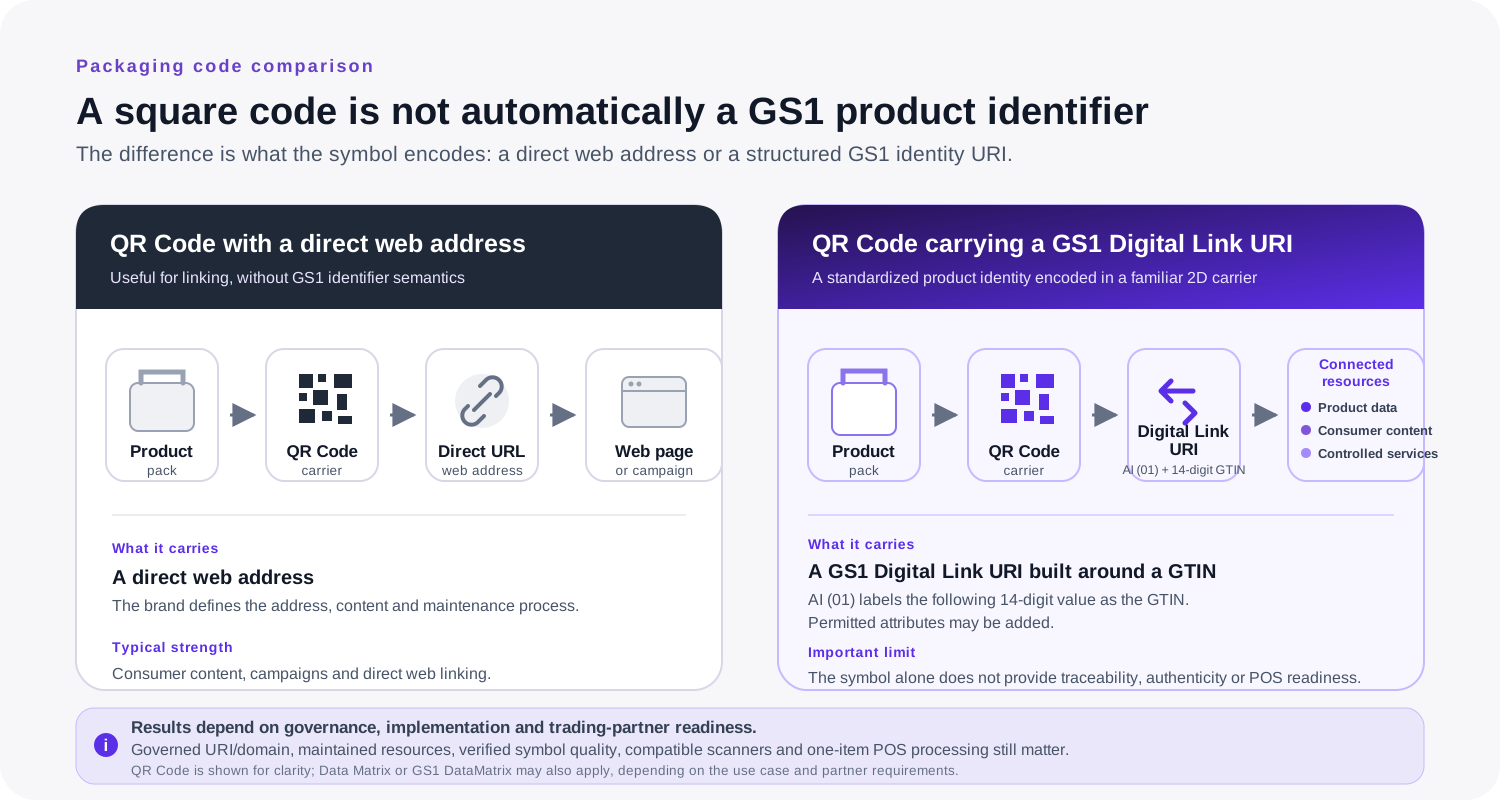
Original GreyBath educational diagram based on the cited GS1 standards; no barcode shown is intended for scanning.
Neither choice is automatically superior. A campaign QR can remain appropriate for a campaign. The important control is that teams stop treating every square black-and-white symbol as interchangeable.
03 · Define the business outcome
Choose the use case before choosing the symbol
GS1's retail guideline recommends choosing data and implementation according to the business use case. Each extra data element creates a responsibility to generate, print, store, process and maintain it correctly. Do not add serialisation because another company uses it.
| Business objective | Likely data and system need | Relative complexity |
|---|---|---|
| Show product-specific information | GTIN and, when using Digital Link, a persistent identity URI and maintained product destination | Low |
| Show ingredients, nutrition, certificates or instructions | GTIN plus governed online product content | Low to medium |
| Add batch or date information | GTIN plus batch/lot or an applicable date AI, variable printing and records | Medium |
| Support recall traceability | GTIN plus batch/lot and a backend that records production and movement events | Medium to high |
| Identify each unit | GTIN plus serial number, unique-code generation and lifecycle records | High |
| Use one code for POS and consumer access | Compliant 2D symbol, supported data, a useful destination and retailer readiness | Medium to high |
A snack manufacturer may begin with product identity and nutrition. A short-shelf-life product may later justify date information. A recall or authenticity objective needs more than a symbol: the company needs reliable backend records that connect the code to the item, batch or event being investigated. A QR code alone neither proves authenticity nor creates traceability.
04 · Clean the identity layer
Start with products and GTINs, not artwork
Confirm that every active product and variant is mapped to the correct current GTIN before any designer changes a pack. Product families often differ by flavour, size, pack weight, bundle quantity, packaging format, market or promotional configuration. A 2D barcode cannot repair an unclear product master.
Product mapGive every active sellable variant an accountable record
| SKU | Product | Variant | Pack size | Current GTIN | Current symbol | Status |
|---|---|---|---|---|---|---|
| SAU-001 | Tomato sauce | Regular | 500 g | Verified in product master | EAN-13 | Active |
| SAU-002 | Tomato sauce | Regular | 1 kg | Verified in product master | EAN-13 | Active |
| SAU-003 | Tomato sauce | Hot | 500 g | Verified in product master | EAN-13 | Active |
GS1 India is the authorised GS1 Member Organisation in India for allocating identifiers that begin with 890. That prefix identifies the Member Organisation that allocated the number; it does not prove where a product was manufactured, and an Indian business may legitimately use a number allocated through another GS1 Member Organisation. GS1's official answer on barcode prefixes and country of origin explains this distinction.
If old products, copied artwork or historic allocations create uncertainty, resolve the ownership and identity first. Do not build a newer data carrier on an unverified product master.
05 · Design the data model
Separate static product data from variable production data
A product contains information that changes rarely and information that can change for every manufacturing run or unit. That difference determines whether the 2D symbol can be fixed in the artwork or must be produced by a variable-data process.
| Data type | Examples | Typical source | Printing implication |
|---|---|---|---|
| Static | GTIN, product name, brand, net quantity, product identity URI | Product master and controlled web content | May be preprinted in artwork when the encoded data is genuinely fixed |
| Variable by batch | Batch/lot, production date, best-before date, expiry date | Production or quality system | Normally generated for the run, either inline on the line or pre-generated through a controlled variable-print process |
| Variable by unit | Serial number | Serialisation or traceability system | Every unit requires a unique generated symbol and a backend record |
Use Application Identifiers precisely
GS1 Application Identifiers, or AIs, define the meaning and format of data elements. They are not interchangeable labels. The official GS1 Application Identifier reference defines, among others:
- AI (01)
- Global Trade Item Number (GTIN), expressed as 14 digits in GS1 AI and Digital Link contexts.
- AI (10)
- Batch or lot number.
- AI (15)
- Best-before date: the quality date, not a synonym for expiry.
- AI (17)
- Expiration or use-by date.
- AI (21)
- Serial number for an individual item.
A product-level identity URI can conceptually remain fixed. Adding AI (10), (15), (17) or (21) changes the data at batch or unit level and therefore changes the code that must be printed. A company with preprinted pouches cannot permanently place next month's batch or expiry inside the original artwork. It may need inline coding, controlled pre-generation or a packaging supplier capable of variable printing. The right method depends on production volume, material, line equipment, verification and reconciliation controls.
06 · Protect current checkout
Keep the existing linear barcode during the transition
For most retail FMCG pilots, dual marking is the safer starting point: keep the established EAN/UPC symbol and add a compliant 2D symbol. Both must represent the same product identity. Do not accidentally encode one GTIN in the linear barcode and another in the 2D code.
One practical retailer question
Ask each important retail or distribution partner: “Can your current POS and receiving systems accept GS1-compliant 2D product barcodes, which symbol and syntax do you support, which data elements do you process, and how should a supplier complete a controlled test?”
Record the answer by partner and location where relevant. A scanner may be capable of imaging a QR Code while the POS software is unable to parse the GS1 Digital Link URI, capture the GTIN or use additional data. Hardware, scanner configuration, POS software, item master and transaction logic all matter. In a dual-marked test, the two symbols should carry the same GTIN and the POS should recognise one item once; placement and configuration must avoid an unintended second scan.
The GS1 retail guideline says that until 2D capability is sufficiently widespread, a retail 2D symbol on pack needs the accompanying linear POS barcode. It also warns that not all imaging scanners will satisfy the 2027 ambition. Treat retailer validation as evidence, not an assumption based on whether a phone or payment app can scan the square pattern.
07 · Separate identity from content
When using GS1 Digital Link, build a persistent identity URI and maintain its destination
A common packaging mistake is encoding a temporary campaign page directly, such as example.com/promotion-october-2026. The campaign ends while packs remain in shops, leaving a code that scans to a dead or irrelevant page.
When the selected carrier and syntax use GS1 Digital Link, the standard allows a company-controlled domain and identifies the GTIN through the AI (01) path. A conceptual product-level identity URI is:
https://id.yourbrand.example/01/{GTIN}
Example interpretation: 01 declares a GTIN; {GTIN} is a placeholder for the correctly padded 14-digit value. Do not print the braces or copy a fictional number.
The persistent identity URI should redirect to a maintained resource, for example https://www.yourbrand.example/products/tomato-sauce-500g. The physical code can remain stable while the destination content is updated. The official GS1 Digital Link quick-start guide explains that the encoded identity URI should not simply be treated as the product page URL and emphasises the importance of redirection.
A GS1-conformant resolver can return different resources or link types for the same identified item, but it is not mandatory for every simple implementation. GS1's current online technologies guidance distinguishes the identity URI, redirection, linksets and resolvers. Start with an architecture the business can keep online; add resolver capability when several audiences or machine-readable resources justify it.
Domain control matters because packaging can circulate for years. Record who owns the domain, DNS account, redirect configuration and content destination, and what happens if the website platform or agency changes.
08 · Avoid premature complexity
You do not automatically need custom software
A brand with 20 SKUs and fixed product-level information may be able to begin with a controlled product spreadsheet or existing product master, maintained pages in its current CMS and, when using Digital Link, persistent identity URIs. Custom development becomes more relevant when information comes from several systems, codes vary by batch or unit, or traceability workflows must connect production, ERP, logistics, retailers and consumer services.
| Situation | Sensible starting point |
|---|---|
| Few SKUs and fixed product information | Existing product master or controlled sheet, existing CMS and correctly structured Digital Link URIs where selected |
| Product data already maintained centrally | Publish or redirect to the existing approved information rather than duplicate it |
| Indian GS1 subscriber evaluating a managed option | Evaluate GS1 India DataKart against the required fields, workflow, price and export/integration needs |
| Batch-level information | Backend batch records, variable-code generation, print controls and a method to serve or process the batch context |
| Unit serialisation, traceability or authenticity claims | Specialist architecture that creates unique identifiers, records lifecycle events and defines verification or exception handling |
DataKart is one official option, not a mandatory prerequisite for GS1 Digital Link. Compare it with the systems and processes the company already operates. A symbol without the required records and controls will not create reliable traceability, recall management or proof of authenticity.
Treat DataKart or another product-data service and any brand-controlled redirect or resolver as separate choices. Use the data platform for the fields and workflows it is approved to govern; keep the URI domain, DNS, redirect mappings, consumer-facing content, data export and supplier-exit controls with named owners unless the chosen contract explicitly covers them. Avoid conflicting copies across DataKart, ERP, spreadsheets and the website by naming one approved source and owner for each field.
09 · Approve data and print
Make 2D data part of packaging quality
Packaging approval already checks artwork, spelling, price declarations, ingredients, nutrition, colour and statutory information. A richer data carrier adds two questions: does the symbol contain the intended identity and attributes, and does it work on the actual package?
Packaging approvalRecord an owner and evidence for every critical check
| Check | Accountable role | Evidence |
|---|---|---|
| Correct product and GTIN | Product or operations owner | Approved product master |
| Correct AIs and values | Implementation and data owners | Decoded test against the approved source |
| Correct identity URI and redirect | Digital or technical owner | Tested URI, redirect and destination |
| Barcode type, size and placement | Packaging and print vendor | Controlled artwork and physical proof |
| Print quality on final material | Quality and packaging | Verification report or documented print-quality test |
| Linear barcode retained where required | Packaging owner | Final approved artwork |
| Online product information approved | Regulatory, quality, product and marketing owners as applicable | Approved content record and live/staging check |
Test the printed proof, not only the PDF
A code can work on a designer's monitor and fail on a pouch or bottle. Reflective film, curvature, ink spread, low contrast, inadequate quiet zones, distortion, small size and poor placement can affect scanning. Test the intended material, printing process and finished form: pouch on the pouch, curved label on the bottle and metallic laminate on the laminate.
GS1 India's barcode verification service assesses print quality and scanning parameters for 1D and 2D barcodes and recommends verification before bulk printing. Treat that report according to its stated scope: it is evidence about barcode print quality and conformance checks, not a blanket certification of the product, label, regulatory compliance, data accuracy, retail acceptance or backend process.
10 · Learn before scaling
Use a planned artwork cycle and a small SKU pilot
Most FMCG businesses periodically revise packs for statutory text, certifications, addresses, claims, pack sizes or brand design. Where commercial and regulatory conditions allow, add 2D-readiness work to the next planned cycle and normal packaging-stock exhaustion. Do not create an emergency reprint merely because 2027 is approaching.
Create a two-print-run decision list instead of a catalogue-wide reprint plan. Review first the SKUs whose artwork will freeze within the next two scheduled print runs, plus any product named by an export or modern-trade partner. Record one decision for each: pilot now, prepare but defer or no current 2D use case. Leave later SKUs for their natural artwork cycle unless a verified requirement changes the priority.
SME implementation flowSwipe sideways to follow all nine stages
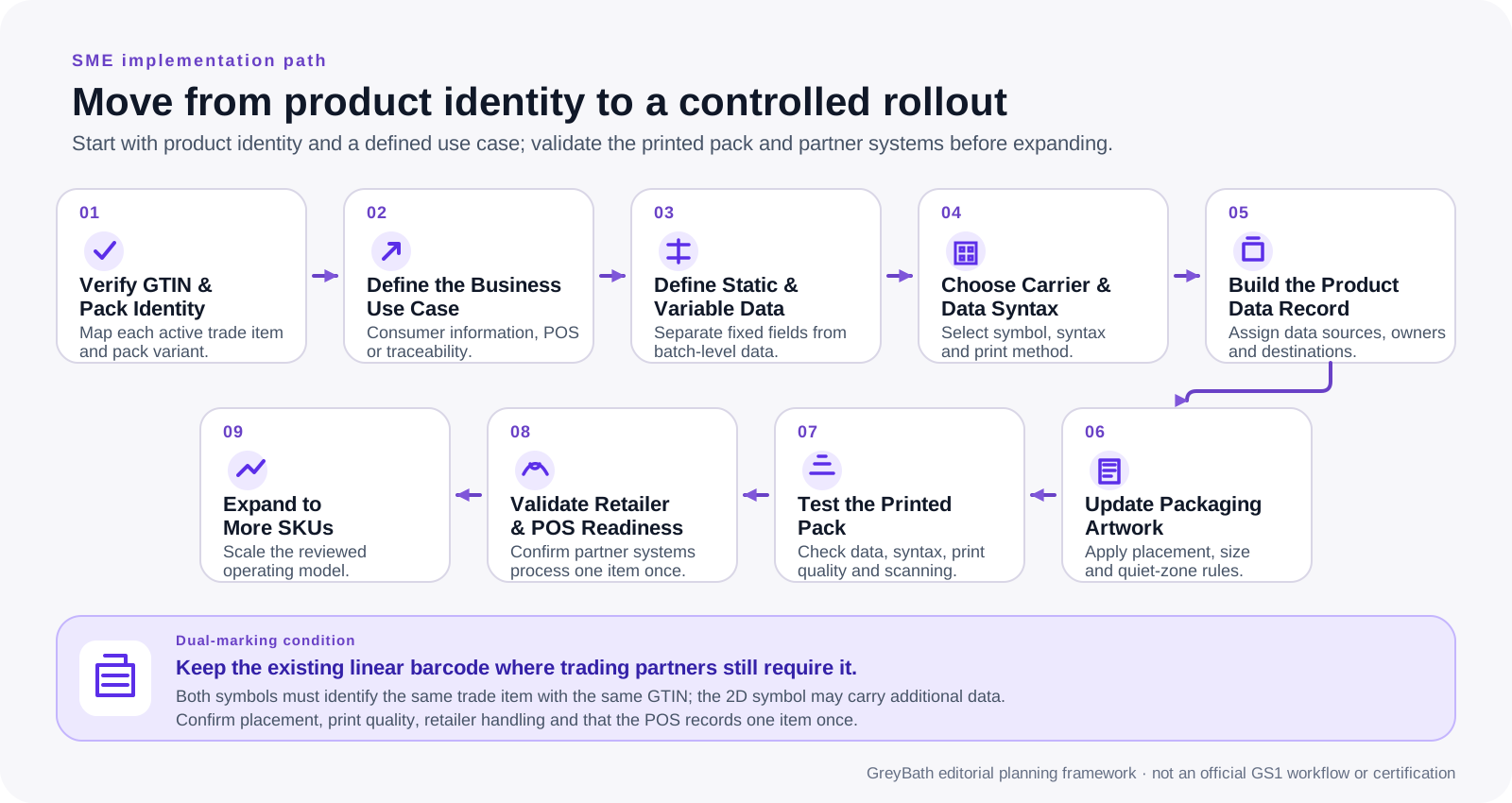
Original GreyBath implementation diagram based on the cited GS1 guidance; it is not a GS1 certification workflow.
Choose a pilot group that exposes different constraints instead of the easiest five products.
| Product type | Reason to include it |
|---|---|
| High-volume SKU | Tests ordinary production and retail conditions |
| Small pack | Tests artwork space, symbol size and placement |
| Product with frequent content changes | Tests content governance and durable redirection |
| Product where batch or date matters | Tests whether variable data is genuinely needed and printable |
| Product sold through a key retailer | Creates a practical partner-readiness test |
The pilot is not a presentation exercise. It should reveal data, print, scan, content, redirect and retailer-processing failures before they affect the full catalogue.
11 · Operate the digital layer
Show product information, not an advertising obstacle course
If a person scans a specific pack, send them to information about that product rather than the corporate homepage. A useful mobile page may show the product and pack size, ingredients, nutrition, allergens, certifications, storage and usage instructions, consumer-care contact, optional recipes or videos, and recycling guidance where relevant.
Keep the page fast. Do not make core product information conditional on a phone number, OTP or marketing consent without a legitimate access reason. Loyalty, warranty or promotion registration can remain an optional path after the information the person requested.
Assign one coordinating product-data owner
Quality may approve one field, regulatory another and marketing the description. One function should still coordinate the product record across packaging, website, e-commerce listings, retailer submissions, certificates and identity-URI destinations. That coordinator does not invent facts; the role makes each approved source, owner and effective date visible.
Monitor the identity URI, redirect and destination as long-lived packaging infrastructure. A redesign, domain transfer or agency change must not silently break codes already in the market.
12 · Hypothetical example
Sahyadri Foods prepares six products without buying a new platform
Sahyadri Foods is fictional. It is not a GreyBath client, and this example is not a performance claim, benchmark or compliance result.
The company sells six packaged foods through distributors, local supermarkets and two regional chains. Every pack has an EAN-13 and an ordinary QR that opens the homepage. Product pages exist; product data is maintained in a controlled spreadsheet and packaging artwork; batch and date information are printed during production. A packaging redesign is planned for the next year.
Phase one: product-level identity
The team verifies the six products and GTINs, confirms the source for each approved product fact and creates one product-level identity URI per GTIN. Each URI redirects to the relevant product page. It keeps batch and dates outside the new QR for now, because the first use case is product information rather than batch traceability. The EAN-13 remains on each pack.
The result is a controlled product-specific scan experience and a dual-marked pack without changing the production-line coder. The team tests the printed material, verifies every redirect and asks both regional chains how they want 2D test packs submitted.
Phase two: a decision based on evidence
After retailer tests and a review of recall and date-management needs, the company decides whether encoding AI (10), (15) or (17) would create enough operational value. That second phase may require variable-code generation, coding-equipment changes, backend records, quality reconciliation and updates to retailer processing. The company does not pay for that complexity until it can name the use case and operate the controls.
13 · Make the pilot accountable
Measure operating evidence, not the presence of a QR
| Measure | What it reveals |
|---|---|
| Physical scan and verification result | Whether the printed symbol performs on the intended package |
| Correct identity decode rate | Whether every test SKU returns the intended GTIN and attributes |
| Correct redirect rate | Whether each identity URI reaches the right maintained resource |
| Product-data completeness | Whether important visible information is approved and present |
| Broken destination count | Whether packaging links remain operational over time |
| Retailer test result | Whether each relevant partner can process the symbol and required data |
| Consumer scans and useful actions | Whether people use the information; interpret it in the context of product volume and use case |
| Content freshness | Whether changes reach the digital destination under an accountable process |
Scan count alone is not success. A technical or low-volume product may receive fewer consumer scans than a snack. The stronger question is whether the code, data, destination and partner systems work for the use case selected.
Prepare this brief before speaking to vendors
Implementation briefComplete the decisions before asking for a proposal
| Decision | Your documented answer |
|---|---|
| Products in phase one | List representative SKUs and owners |
| Existing GTIN and symbol | Record verified identity and current artwork |
| Business use case | Consumer information, POS, date management, traceability or another named need |
| Identity level | Product, batch/lot or individual unit |
| AIs and static/variable fields | Specify every proposed data element and approved source |
| Identity URI and destination | Record domain owner, redirect pattern, content owner and fallback |
| Packaging and coding process | Material, artwork cycle, printer, production coder and line constraints |
| Retailer readiness | Partner, supported symbol/syntax, data processed and test evidence |
| Linear barcode | Confirm it remains and encodes the same GTIN during transition where required |
| Verification and approval | Name the physical tests, approvers, evidence and exception route |
Completing this table makes it harder to buy a symbol-generation tool when the real need is product-data cleanup, or to buy a large platform for a problem the existing CMS and controlled process can handle.
Use the brief to separate responsibilities: GS1 and regulatory advice, packaging and print verification, retailer and POS testing, and product-page, redirect or integration work. One supplier should not be assumed to own every layer.
14 · Apply the guide responsibly
Where this guide does and does not apply
This guide is for retail consumer goods and FMCG-style packaged products. Regulated healthcare has established GS1 DataMatrix applications and sector-specific requirements; the retail guideline explicitly separates regulated healthcare implementation. Tobacco, medical devices, pharmaceuticals and other regulated categories may have their own mandatory carriers, data and processes. Obtain the applicable regulatory and GS1 guidance rather than copying a grocery-pack implementation.
GS1 readiness also does not establish FSSAI, Legal Metrology, extended producer responsibility, label-content or retailer-policy compliance. Confirm the rules that apply to the exact product, pack, market and sales channel with the accountable specialist.
A B2B industrial component that never passes through retail POS may also need a different carrier and standard. Exporters must check destination-market and trading-partner requirements. Similar-looking 2D symbols do not imply identical data or obligations.
A sensible sequence for an FMCG SME
- Verify active products, variants and GTINs.
- Name the first business use case.
- Separate static, batch-level and unit-level data.
- Select the applicable GS1 syntax and symbol with qualified guidance.
- Keep the current linear barcode during transition where required, with the same GTIN.
- Prepare the identity URI, redirect and approved product information.
- Update artwork during a controlled packaging cycle.
- Test and verify the real printed pack.
- Complete controlled tests with relevant retailers and distributors.
- Expand only after the pilot evidence is acceptable.
The final takeaway
The important shift is not that QR codes are fashionable. It is that standards-based product identity and digital resources can work together. One well-operated implementation may eventually support POS identification, consumer information, batch or date data, traceability and digital engagement, but no SME needs every capability on day one.
The strongest first implementation is the one where the product identity is correct, the printed symbol is reliable, the destination remains controlled, the data has accountable owners and the process is simple enough to maintain.
15 · Quick answers
Common questions from Indian FMCG teams
Is a 2D barcode mandatory for every FMCG pack in India in 2027?
No universal Indian packaging deadline follows from GS1 Ambition 2027 itself. GS1 describes it as an industry goal for retail POS systems to read and process existing linear barcodes and defined GS1 2D barcodes by the end of 2027. Check FSSAI, Legal Metrology, sector, export-market, contract and trading-partner requirements separately for the exact product and pack.
Can an FMCG brand keep its EAN-13 barcode?
Yes, unless an applicable regulation or trading partner requires another approach. GS1 says linear EAN/UPC barcodes are not going away, and a product adopting 2D normally retains its linear POS barcode during the transition. Do not remove a working EAN-13 until the selected standard, retailer systems and controlled tests support that decision.
Is the QR code already on the pack enough?
Not necessarily. An ordinary marketing QR may only open a web page and may contain no GS1 product identity. Decode the current value, name the intended use case and confirm the required GS1 carrier, syntax, data, printing and partner support before treating it as a retail 2D barcode.
Optional digital implementation support
Connect the pack only after the operating model is clear
Many SMEs can begin without custom software. If a controlled pilot later proves a specific gap in maintained product-information pages, redirect resilience, APIs or product-data workflows, GreyBath can help implement that digital layer. The barcode standard, GTIN allocation, packaging compliance, print verification and regulatory approval remain with the relevant GS1 Member Organisation and accountable barcode, packaging and regulatory specialists.
Research record
Official sources
Official GS1 and GS1 India material was reviewed on 1 October 2026. It supports the standards, transition and service descriptions stated here; it does not certify this GreyBath guide or any reader's implementation.
- GS1: 2D Barcodes at Retail Point-of-Sale Implementation GuidelineAmbition 2027, transition-period dual marking, symbol options, data selection, brand and retailer readiness, and the healthcare scope distinction.
- GS1 Digital Link Standard: URI SyntaxThe web-compatible expression of GS1 identifiers, domain flexibility and AI-based URI structure.
- GS1: Quick start guide for GS1 Digital LinkDomain, identity-URI and redirection principles.
- GS1: Online technologies and how they fit togetherThe distinction between Digital Link URIs, redirects, linksets and optional resolver use.
- GS1 Application Identifier referenceAI (01), (10), (15), (17) and (21) meanings.
- GS1: Does a GS1 prefix show country of origin?Why the allocating Member Organisation is not evidence of manufacturing origin.
- GS1 India: Retail and online marketplaceIndia-facing Sunrise 2027 context and the industry target for retail scanners to support both 2D and 1D symbols.
- GS1 India: GS1 Digital Link and QR codesIndia-facing product-information and data-sharing examples.
- GS1 India: Barcode VerificationPhysical symbol print-quality parameters and the scope of its verification service.
- GS1 India: DataKartThe optional managed product-data and Digital Link QR capabilities described by GS1 India.
Keep reading
More practical thinking from GreyBath across design, engineering and growth.
All articles