

Your Product Sample Reached the Buyer. Did Anyone Find Out Whether It Worked?
A practical system for B2B manufacturers to qualify sample requests, preserve trial context, collect technical feedback and connect accepted samples to commercial follow-up.

Share this article
Browse all insightsA manufacturer receives an enquiry from a prospective customer.
Cover disclosure: The cover photograph is an AI-generated editorial illustration with fictional people, product and records. It does not depict a GreyBath client, a real buyer trial or a verified product result.
The customer is interested in using one of the manufacturer's components in its equipment.
Before placing an order, the customer's technical team wants to evaluate a sample.
Sales arranges the material.
Stores prepares the package.
The courier collects it.
A few days later, the tracking portal shows:
Delivered.
The sales executive updates the enquiry:
Sample Sent.
Everyone assumes the opportunity is progressing.
Three weeks later, the sales manager asks:
What happened to the customer who requested the sample?
The executive replies:
We sent it. They haven't placed an order yet.
The manager asks another question:
Did they test it? Was it suitable? Are they waiting for anything from us?
Nobody has a clear answer.
The sample reached the customer.
The manufacturer knows the dispatch date and courier reference.
But the company does not know whether the sample was evaluated or what the customer decided.
The delivery was completed. The sales evaluation was not.
For manufacturers and industrial suppliers, this is an important distinction.
Sending samples can be part of winning new business.
However, a sample is not automatically a qualified opportunity, a completed technical trial or a future purchase order.
A better process connects the material sent to the customer's evaluation and next decision.
It does not necessarily require another CRM or custom application.
It starts with understanding what happens after dispatch.
A sample request is more than a request for free material
Consider a manufacturer supplying industrial rubber components.
A prospective customer requests five pieces of a rubber seal.
The company's sales executive may immediately arrange dispatch.
But before sending the material, the supplier needs to understand its intended use.
Is the customer developing a new product?
Is it replacing an existing component?
Does it need to test fitment?
Is it comparing suppliers?
Is the requested material suitable for the application described?
Does the customer have an expected testing schedule?
Who will evaluate the sample?
These questions help establish whether sending the material is the appropriate next step.
Understand the customer's application
Industrial sample programmes often distinguish genuine business applications from general requests for free products.
For example, Henkel's industrial sampling terms ask applicants to identify their industry and intended application. 3M's commercial graphic-film sampling programme also specifies eligibility conditions based on business use and suitable equipment. Henkel Adhesives
An SME does not need to copy these companies' policies.
However, it can apply the same operating principle:
Before sending a sample, understand what the customer intends to evaluate.
That information helps Sales and the technical team select an appropriate product and define a useful follow-up.
Not every request should be rejected
A new customer may genuinely be exploring an application without knowing its final production quantity.
An engineering team may need preliminary samples before it can estimate commercial demand.
A distributor may request material for evaluation by an end customer.
These can all be legitimate situations.
The purpose of qualification is not to reject everyone who cannot immediately promise an order.
It is to identify the request's purpose and decide what support is appropriate.
Sample delivery, testing and approval are different stages
Many sales reports contain a column labelled:
Samples Sent
This is useful information.
But it describes an activity, not the final outcome.
Consider the following stages.
| Stage | What it establishes |
|---|---|
| Sample requested | A prospective customer has requested material |
| Request reviewed | The supplier has assessed the application and supply decision |
| Sample dispatched | Material has been recorded as sent |
| Sample delivered | Delivery has been confirmed through the agreed evidence |
| Trial scheduled | The customer has identified a planned evaluation |
| Trial completed | The evaluation has been performed |
| Technical outcome recorded | Relevant findings have been communicated or documented |
| Commercial next step agreed | The parties know whether to proceed, revise, retest or close the opportunity |
These stages should remain distinguishable.
A sample may be delivered but never tested.
A sample may be tested and found unsuitable.
A sample may pass the customer's technical evaluation without receiving purchasing approval.
And a customer may place an order without any physical sample being required.
A completed courier delivery should not automatically advance a sales opportunity to technically approved.
The buyer should know what the sample is intended to prove
Imagine a manufacturer supplying a replacement industrial seal.
The buyer says:
Send us a sample so we can check whether it works.
What does “works” mean?
Does the customer want to check physical fit?
Material compatibility?
Installation?
Operation under particular conditions?
A specified functional requirement?
The answer depends on the product and application.
Define the evaluation purpose
Before dispatch, the supplier and buyer should establish the relevant evaluation question.
For example:
The customer will assess whether the proposed seal fits the designated equipment and meets the specified functional requirements under its approved trial procedure.
This is much more useful than:
Customer testing sample.
It identifies what the buyer wants to learn.
The technical acceptance criteria should come from the authorised customer or technical team.
The sales executive should not invent performance limits.
Do not promise technical suitability without evidence
A component may fit physically but still require additional evaluation.
For example, a rubber seal may fit the intended assembly but fail another applicable performance requirement.
Likewise, a material may work in a laboratory test but require further validation before being accepted for routine production.
The company should record the actual trial result.
It should not treat a positive informal comment as final technical approval.
For regulated or safety-critical applications, follow the required engineering, validation and certification procedures.
A CRM status is not a technical certification.
A worked example: ten sample requests and only four known trial outcomes
Consider a fictional company called Western Industrial Components Pvt Ltd.
The company supplies engineered rubber components to machinery manufacturers in India.
This is a hypothetical example, not a GreyBath client project.
During one reporting period, the sales team receives ten sample requests.
The requests concern different prospective customers.
For simplicity, assume each request involves one sample kit.
The company reviews the requests and dispatches eight kits.
Two requests remain pending qualification or approval.
What the sales report shows
The manager's usual report states:
Ten sample requests received.
Eight sample kits dispatched.
This suggests that most requests have been handled.
But it does not tell management what happened after dispatch.
What a more detailed review discovers
Of the eight dispatched sample kits:
Seven have confirmed delivery.
One remains in transit.
Of the seven delivered kits:
Four have a recorded technical evaluation outcome.
Two are awaiting scheduled customer trials.
One has no confirmed testing status.
The four completed evaluations produced:
Two technically acceptable outcomes.
Two outcomes where the proposed component was unsuitable for the intended application.
The complete position is:
| Sample-trial position | Number of requests |
|---|---|
| Request received but sample not dispatched | 2 |
| Sample dispatched, still in transit | 1 |
| Delivered, trial scheduled | 2 |
| Delivered, evaluation outcome unknown | 1 |
| Trial completed, technically acceptable | 2 |
| Trial completed, technically unsuitable | 2 |
| Total requests | 10 |
All figures are hypothetical.
Notice that eight samples were dispatched, but only four have known technical evaluation outcomes.
The report is not evidence that the remaining four dispatched samples have failed.
Their circumstances are different.
One is in transit.
Two have planned trials.
One has an unknown evaluation position.
The important management question changes
Instead of asking:
Why did eight samples produce so few orders?
Management can ask:
Which delivered samples have completed evaluation, which are awaiting testing and which require a follow-up to establish their status?
That leads to more useful actions.
The company can coordinate with the customer who has not confirmed its evaluation schedule.
It can review technical feedback from unsuccessful trials.
It can discuss the next commercial step with customers who found the samples suitable.
And it can avoid repeatedly calling customers whose trial dates have not arrived.
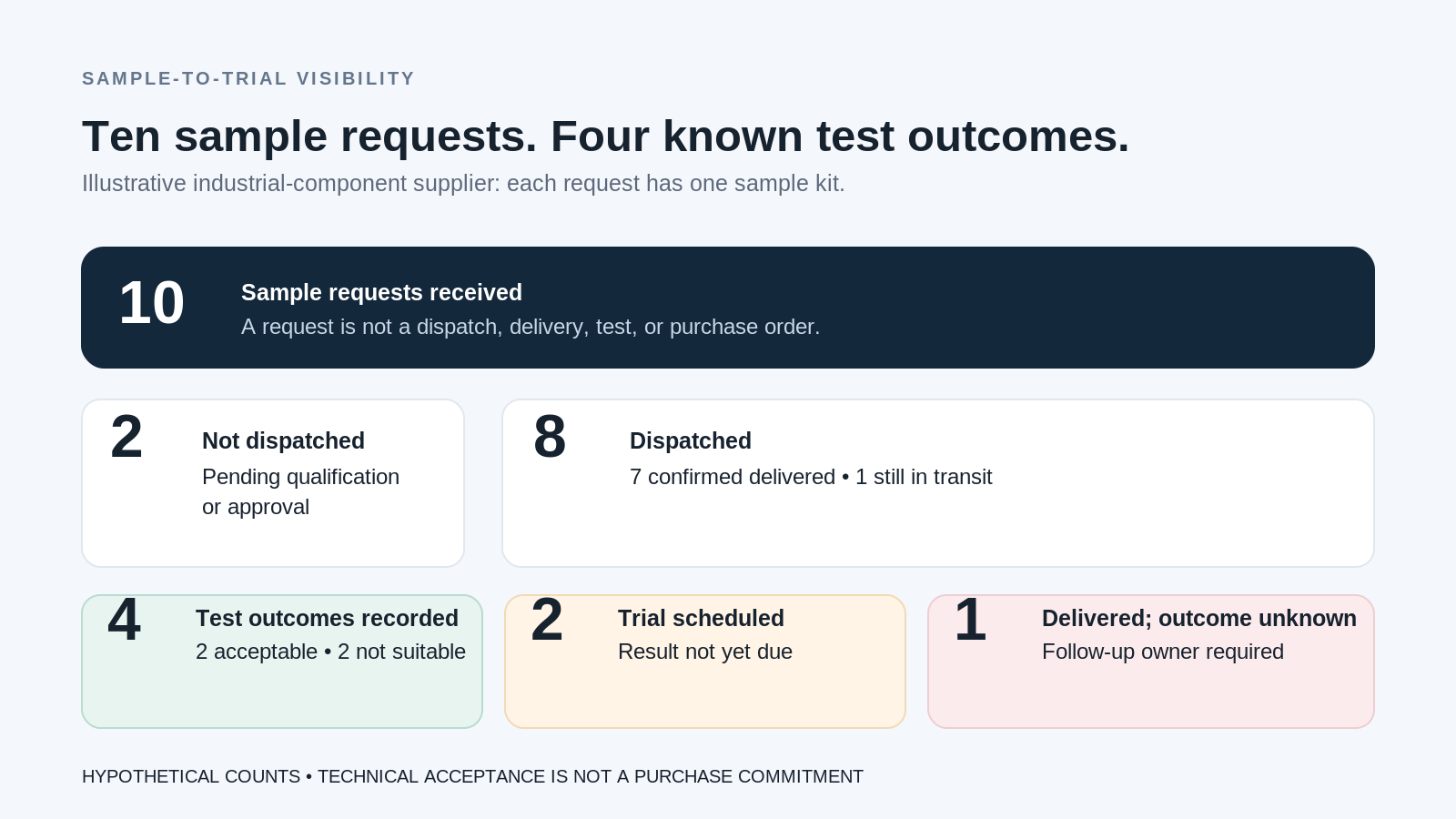
Owner-supplied 2D educational diagram based only on the fictional sample funnel in this article.
Technical acceptance is not the same as an order
Return to the fictional example.
Two customers found their samples technically acceptable.
Does this mean the company has won two orders?
Not necessarily.
One customer's procurement department may request a commercial quotation.
Another may need final internal approval before starting production.
A third party may control supplier registration.
The buyer may also be comparing several technically acceptable suppliers.
The business should therefore distinguish:
Technical evaluation completed
from
Commercial purchase decision made.
What happens after a successful trial?
For an appropriate opportunity, the next stage may involve commercial discussion.
Sales might need to confirm the expected quantity, agreed specification, purchase schedule or quotation requirements.
The buyer may need a supplier-registration process.
The supplier may need additional production or delivery information.
These steps depend on the relationship.
A technical pass is encouraging, but it is not a purchase commitment.
What happens after an unsuccessful trial?
A technically unsuitable sample does not automatically mean the customer relationship is lost.
The technical team may identify another appropriate product.
The customer may need a different specification.
Or the proposed product may genuinely be unsuitable.
The correct decision could be to recommend another authorised option, investigate the findings or close the opportunity.
Do not repeatedly send additional samples without understanding why the previous one failed.
Sample dispatch has a cost even when the material is free
Many manufacturers provide samples at no charge to prospective customers.
That may be an appropriate commercial decision.
But the company still incurs costs.
These can include material, preparation, packaging, transport and employee time.
A hypothetical cost calculation
Consider the eight sample kits dispatched by Western Industrial Components.
Assume the following illustrative direct costs per kit:
| Cost component | Amount per kit |
|---|---|
| Sample material | ₹450 |
| Courier | ₹180 |
| Packing and handling | ₹70 |
| Total illustrative direct cost | ₹700 |
For eight kits:
8 × ₹700 = ₹5,600
The company has incurred ₹5,600 in the stated direct costs.
This excludes any additional technical support, sales time, overhead and other expenses.
It does not establish that the company lost ₹5,600.
Samples may support valuable sales opportunities.
But the business should know how much effort it is committing.
Avoid treating every sample as a guaranteed investment return
Suppose one customer eventually places a substantial order.
That does not mean every sample-dispatch process is automatically efficient.
Similarly, a customer failing a technical test does not necessarily mean the sample was wasted.
The trial may have established that the product was unsuitable before a larger commercial commitment was made.
The business should review sampling costs alongside the actual outcomes.
Do not calculate a guaranteed return from expected future orders.
Not every prospective customer needs a free sample
A manufacturer should establish when samples are appropriate and whether they should be free, chargeable or subject to another agreed arrangement.
For example, a standard low-cost sample may be suitable for an early technical evaluation.
A custom-manufactured component may require additional engineering or production expense.
A buyer requesting repeated samples without clear evaluation plans may justify a commercial discussion before more material is supplied.
A large industrial product may be better evaluated through a demonstration, technical documentation or a separately agreed trial.
Set a proportionate approval policy
A useful internal policy can distinguish ordinary samples from requests requiring additional approval.
For example:
Standard sample: Sales may arrange supply within authorised limits.
High-cost sample: Commercial approval required.
Custom-developed sample: Technical feasibility and commercial conditions reviewed.
Repeated request: Previous results and the reason for another sample reviewed.
Sensitive or restricted product: Relevant technical, legal and handling requirements verified.
These are suggested policy categories, not universal industry rules.
The objective is sensible use of resources without creating unnecessary bureaucracy.
Use one sample reference throughout the process
When Sales arranges a sample, several departments may become involved.
The technical team identifies the material.
Stores prepares the kit.
Dispatch books the courier.
The customer receives and tests it.
Sales follows up.
If every department uses a different reference, reconstructing the history becomes difficult.
Introduce one stable sample-request reference
For example:
Sample Request: SR-2026-047
The record can link to the relevant product, dispatch information, customer contact and evaluation.
If one request contains several distinct sample variants, each variant should be identifiable where necessary.
A request reference and a physical sample identifier do not always serve the same purpose.
The request reference follows the commercial evaluation.
A sample or lot reference identifies the material actually supplied.
Preserve relevant lot information
Where the product and evaluation require traceability, record the correct batch or lot identifier.
For example, Odoo 19 supports lot-number tracking on outgoing delivery orders when the relevant inventory features and product settings are configured. Odoo
This can be useful when the customer reports a result and the manufacturer needs to establish which material was tested.
However, not every ordinary sample requires detailed lot-level tracking.
Apply the level of traceability appropriate to the product and its intended use.
A reusable sample-tracking register
A small manufacturer can begin with a controlled spreadsheet.
The objective is to connect the original enquiry with the customer's evaluation and the next commercial action.
| Field | Example |
|---|---|
| Sample request ID | SR-2026-047 |
| Customer | ABC Industrial Equipment |
| Sales owner | Assigned sales executive |
| Customer technical contact | Authorised evaluator |
| Sample item | Engineered rubber seal |
| Product or variant reference | Approved internal reference |
| Intended application | Customer's specified equipment |
| Trial purpose | Fit and relevant functional evaluation |
| Quantity requested | 5 pieces |
| Sample approval | Approved |
| Dispatch reference | Approved dispatch/courier reference |
| Sample or lot identification | Where required |
| Delivery position | Confirmed received |
| Expected evaluation date | Customer-agreed date |
| Technical evaluation status | Scheduled |
| Recorded findings | Pending |
| Commercial next step | Awaiting evaluation |
| Next follow-up | Agreed review date |
| Responsible person | Sales owner |
| Final outcome | Open |
This is an illustrative structure.
The company should adapt it to the information genuinely required.
Avoid requesting unnecessary confidential technical details or personal information.
Keep the spreadsheet controlled
A shared register is useful only when employees maintain it.
Define who can create requests, update dispatch information, enter technical results and change commercial outcomes.
A salesperson should not independently change a failed technical evaluation into a pass simply to advance the opportunity.
Likewise, a completed trial should not remain marked pending because nobody has updated the register.
The official CRM, ERP or inventory system should remain authoritative for the records it owns.
The spreadsheet should not create a second independent stock or sales ledger.
Follow up according to the customer's trial, not an arbitrary sales reminder
A common sales practice is to schedule a reminder a few days after dispatch.
But not every sample can be tested immediately.
A customer may need to schedule machinery downtime.
Its engineering team may be occupied with another project.
The material may need to be tested during a planned production run.
The sample may require preparation before evaluation.
Calling repeatedly before the agreed trial date can create unnecessary pressure without producing useful information.
Establish the expected evaluation schedule
At the appropriate stage, ask the customer when the sample is expected to be tested.
Agree on a sensible review point.
If the evaluation is delayed, record the updated position.
The objective is to know what is happening, not to force every buyer into the same follow-up interval.
A useful follow-up message
After the agreed evaluation period, the sales executive might write:
Hi, we wanted to check whether your team has completed the trial of the sample shared against SR-2026-047. Let us know the outcome or any observations from your technical team. Based on the results, we can discuss the next step.
This approach is more useful than repeatedly asking:
Any order update?
The buyer may not be ready to discuss purchasing.
The immediate question is whether the product was evaluated and what was learned.
A customer saying “sample received” is not technical feedback
Suppose the buyer replies:
Yes, received the material. Thank you.
The sales executive records:
Positive response.
That is understandable, but it can be misleading.
The message confirms receipt.
It does not establish that the product was evaluated.
A more accurate record would be:
Delivery confirmed. Evaluation pending.
Useful trial outcomes
Depending on the product, the internal record may distinguish:
| Evaluation outcome | Meaning |
|---|---|
| Technically acceptable | Customer reports that defined evaluation requirements were satisfied |
| Technically unsuitable | Customer reports that one or more required conditions were not met |
| Trial incomplete | Evaluation started but did not reach a valid conclusion |
| Trial scheduled | Evaluation has not yet occurred |
| Additional information required | Customer needs relevant information or clarification |
| Outcome unknown | No reliable evaluation position has been established |
| Not proceeding | Customer is not continuing, with reason recorded where available |
These are suggested business statuses.
They are not substitutes for formal testing reports or approvals where those are required.
The important principle is that the company should record what the buyer actually communicated.
Do not convert polite messages into technical approval or commercial commitment.
When Sales and the technical team disagree
A customer may tell Sales:
The sample looks good.
The technical report may contain an unresolved issue.
Alternatively, the technical team may report satisfactory results, but Purchasing may reject the proposal for commercial reasons.
These differences should remain visible.
Separate technical suitability from commercial interest
A useful opportunity can have two independent positions.
Technical position: Evaluation completed, pending or unsuitable.
Commercial position: Quotation requested, commercial review ongoing, approved order received, not proceeding or another defined state.
For example:
Technical status: Acceptable for the stated evaluation.
Commercial status: Awaiting customer procurement decision.
That is a more reliable description than a single label:
Qualified Lead.
The manufacturer can then identify the correct next action.
Sales can coordinate commercial follow-up.
The technical team can handle unresolved engineering issues.
Management can review the overall opportunity without confusing the two.
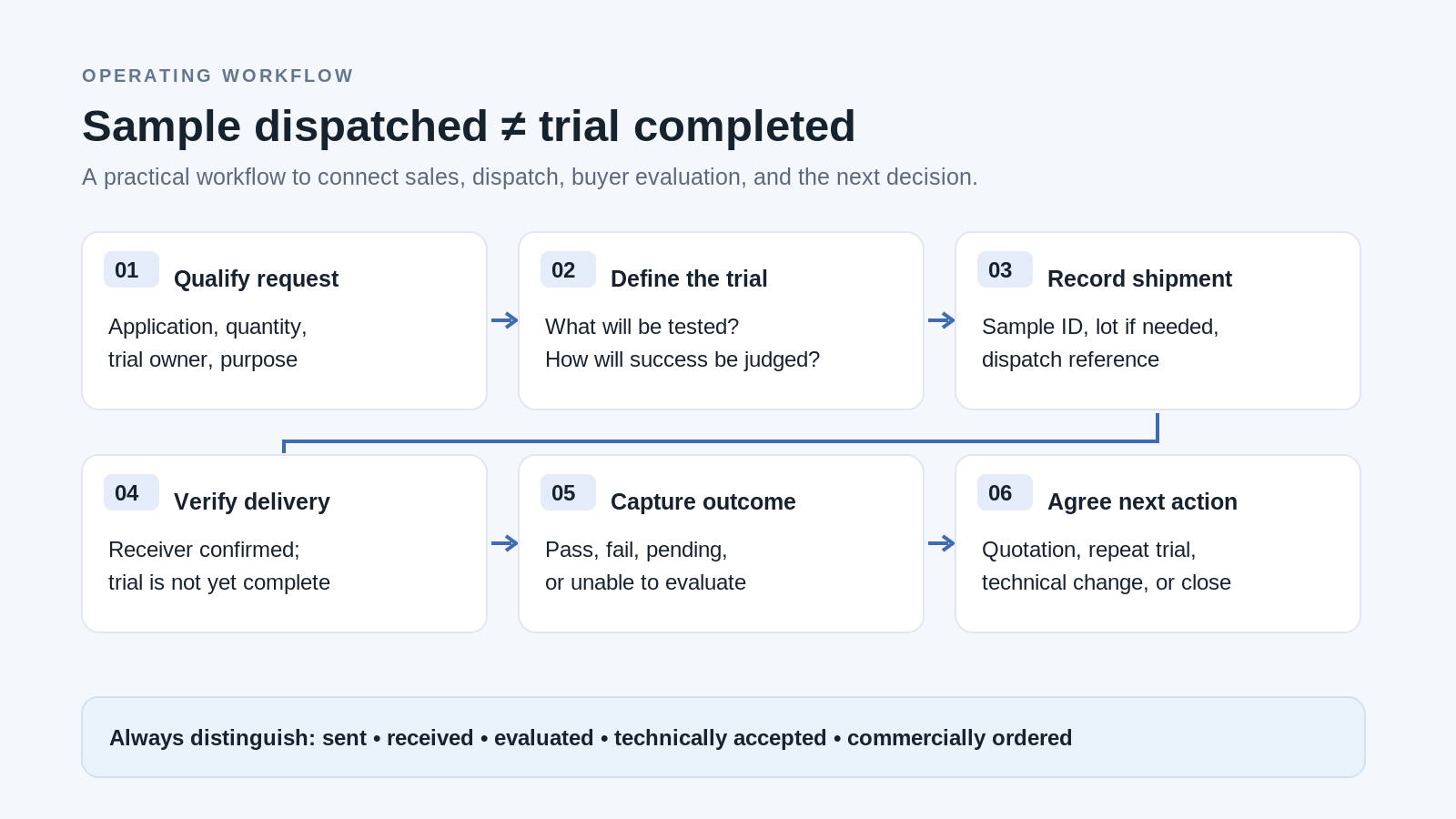
Owner-supplied 2D educational workflow; it is not a screenshot of a client CRM.
Existing CRM software may already handle the follow-up
Before building another application, review the current CRM.
Many systems already support tasks, owners and reminders.
Odoo 19 allows follow-up activities to be associated with leads and opportunities. Its documentation describes activity plans, assigned users, due dates and subsequent actions. Odoo
Zoho CRM also supports linked tasks with owners, deadlines and customer-related records. Zoho Corporation
For a small sales team, these features may be sufficient.
Configure the process before considering custom development
A CRM might already support:
Customer enquiry records.
Sample-request fields.
Sample dispatch references.
Expected trial dates.
Follow-up tasks.
Technical outcome fields.
Sales opportunity stages.
The exact capability depends on the software edition and configuration.
The company may only need to add relevant fields, create a suitable view and train employees to use it.
When another application becomes unnecessary
Suppose a manufacturer sends ten samples each month.
One sales executive owns the requests.
The technical team provides feedback promptly.
The CRM already records customer activities.
A separate sample-management portal may add complexity without meaningful value.
The better solution may simply be a controlled CRM process.
When a connected workflow becomes useful
A more structured application becomes relevant when sample-related information is spread across several systems.
For example:
CRM: Customer enquiries and sales owners.
Inventory or ERP: Sample stock and dispatch transactions.
Technical department: Sample approval and evaluation information.
Courier or logistics provider: Shipment status.
Management: Pending trials and commercial opportunities.
Employees may otherwise need to update several separate records.
A connected workflow could bring the relevant information together.
However, the design should define which system is authoritative for each activity.
Do not create a second inventory system
If the ERP already records sample issues and stock movements, another application should not maintain independent stock quantities without proper reconciliation.
It may be more appropriate to link the CRM sample request to the ERP dispatch reference.
Check integration feasibility
A proposed integration should be assessed against actual supported APIs, authorised exports, access permissions and data quality.
A courier tracking portal does not automatically provide an accessible integration interface.
Likewise, a CRM field should not be treated as a verified technical result merely because an employee populated it.
The software should preserve the source and meaning of important information.
Automated follow-ups need limits
A business may want to automate reminders when a sample is delivered.
That can be useful.
But automation should follow the actual process.
For example, a delivery confirmation could prompt the sales owner to check whether an evaluation date has been agreed.
It should not automatically send a message stating that the customer must have completed testing.
Avoid excessive reminders
A customer may already have explained that the trial will occur next month.
Repeated automated reminders every few days can damage the business relationship.
The system should use the agreed next-action date.
Where the buyer requests no further contact, that preference should be respected.
Avoid invented AI-generated feedback
AI-assisted systems may help organise customer emails or suggest follow-up tasks.
But an AI summary should not invent trial results or classify a customer as technically satisfied without reliable evidence.
Any extracted result should be reviewed where it affects a significant technical or commercial decision.
For a low-volume process, ordinary CRM tasks may be more reliable and economical than AI automation.
What management should measure
A sampling programme should not be judged only by the number of kits dispatched.
Useful measures depend on the company's objectives.
Samples awaiting evaluation
Track delivered samples for which the technical evaluation has not yet been completed.
Distinguish scheduled trials from unknown outcomes.
A delayed trial is not automatically a lost opportunity.
Sample outcome visibility
Measure the share of delivered samples for which a defined evaluation outcome is known.
For the fictional example:
Seven samples delivered.
Four evaluation outcomes recorded.
Therefore:
4 ÷ 7 × 100 = approximately 57.1%
This is a hypothetical reporting measure.
It does not mean the remaining 42.9% failed.
It means their final technical outcomes were not recorded at that point.
Technical acceptance
Record how many completed evaluations met the relevant requirements.
Use an appropriate denominator.
For example, two acceptable results out of four completed evaluations would represent 50% of completed evaluations in the fictional scenario.
That is not an industry benchmark.
Nor does it represent the percentage of all samples expected to produce purchase orders.
Samples progressing to commercial discussion
Track cases where the customer requests a quotation, commercial review or other purchasing discussion after evaluation.
Keep this separate from technically acceptable outcomes.
Confirmed orders from sampled opportunities
Identify completed commercial orders linked to sampling activity.
The reporting should define how repeat samples and multiple customer opportunities are counted.
Do not describe every future order from a sampled customer as directly caused by the sample.
Cost of samples supplied
Track relevant material, preparation and shipping expenses.
For higher-cost programmes, include other attributable costs where reliable information is available.
The purpose is to understand resource use.
Reasons for unsuccessful evaluations
Classify actual customer feedback.
For example, the buyer may report technical incompatibility, a change in requirement or an unsuccessful trial.
Do not assign a reason without evidence.
Odoo 19 supports recording reasons when opportunities are marked lost, illustrating how existing CRM software can preserve relevant sales outcomes. Odoo
What if the customer does not respond?
Not every customer will provide a detailed evaluation report.
Some buyers may delay testing.
Others may decide not to proceed.
Some enquiries may never have represented a strong commercial opportunity.
A manufacturer should have a reasonable way to close or pause inactive requests.
Preserve what is known
For example:
Sample delivered: Confirmed.
Technical trial: No outcome received.
Follow-up: Two documented attempts over the agreed review period.
Current position: Inactive; outcome unknown.
This is more accurate than recording:
Sample rejected.
The company does not know whether the sample failed.
It knows that no reliable outcome was obtained.
If the customer returns later, the record can be reviewed and reopened through the appropriate process.
Do not repeatedly contact an unresponsive buyer indefinitely simply to keep the CRM opportunity active.
When this approach needs to change
Not every manufacturer uses samples in the same way.
An industrial-component supplier may send individual units for fitment evaluation.
A material supplier may provide a small quantity for a process trial.
A machinery manufacturer may arrange an equipment demonstration rather than physically ship a sample.
A company supplying customised products may require a paid prototype.
Some regulated products may require additional approvals, handling controls, technical documentation or customer validation.
A trial may also involve confidential specifications or commercially sensitive technical information.
The process should reflect the actual product and customer requirements.
Samples are not always necessary
Some customers can make a purchasing decision from existing product information, established specifications, previous approvals or a standing agreement.
Do not force every sales opportunity through a sample stage simply because the CRM contains one.
Likewise, do not send samples automatically to every new enquiry.
Use technical and commercial judgement.
The management decision
When a sales executive reports that ten product samples were requested and eight were dispatched, management has only part of the story.
The more useful questions are:
Why did the customer request the sample?
Was the intended application understood?
Was the correct material sent?
Did it reach the intended evaluator?
Was the evaluation scheduled?
Did the customer complete the trial?
What was the actual technical outcome?
What happens next?
For a small manufacturer, a controlled spreadsheet or configured CRM may be sufficient.
For a business handling many samples across Sales, Technical, Stores and multiple customers, a connected workflow may become worthwhile.
The objective is not to increase the number of calls made by the sales team.
It is to make sure every worthwhile sample request has a clear purpose, a dependable record and an appropriate next action.
A sample delivered is not a sales opportunity completed. The business needs to know whether the customer evaluated it and what decision followed.
Where GreyBath can contribute
GreyBath develops custom web applications, ERP/CRM workflows, dashboards and business-system integrations.
For manufacturers and industrial suppliers, a potential GreyBath implementation could connect customer sample requests with internal approvals, ERP dispatch references, trial dates, technical feedback and sales follow-ups.
Depending on the existing systems, this could include sample-request forms, customer-wise evaluation histories, assigned follow-up tasks, exception alerts and management dashboards.
Where supported APIs or authorised data access exist, GreyBath could assess integration with the company's existing CRM, ERP or logistics systems rather than replacing them.
The implementation would require clearly defined sample policies, technical-approval responsibilities, access permissions and reliable source records.
GreyBath would not independently certify samples, determine technical suitability or guarantee that trials convert into orders.
For smaller businesses, existing CRM features may already provide enough functionality.
GreyBath's implementation opportunity begins when sample requests, dispatch records and customer evaluation results are spread across several teams or applications and need one dependable workflow.
Relevant services include GreyBath ERP, CRM, Portals & Dashboards and GreyBath Custom Web Applications & Integrations.
Sources reviewed
The operational recommendations and product examples above were checked against these primary or official sources. Product features, legal duties and filing requirements can change; verify current applicability before implementation.
Keep reading
More practical thinking from GreyBath across design, engineering and growth.
All articles