

Your Contractor Billed 220 Worker-Shifts. Does Your Factory's Attendance Record Agree?
Use the contract, gate records and supervisor evidence to separate supported work from shifts that still need a decision.

Share this article
Browse all insightsYour contractor billed 220 worker-shifts. The factory’s gate records initially support 198. Approving 198 could leave valid work unpaid. Approving 220 could pay for shifts you can’t verify. Here’s how to close the gap with evidence both sides can review.

Cover disclosure: The cover photograph is an AI-generated editorial illustration with fictional people, invoice and attendance records. It does not depict a GreyBath client, actual workers or a real contractor dispute.
Do this next
- Confirm the billing unit and rate in the contract: shift, hour, fixed fee or output.
- Ask the contractor for a worker-wise statement covering the same period.
- Classify the gap as a possible attendance correction, off-site assignment or unresolved claim.
- Ask the relevant site supervisor to confirm assignments and attach the supporting evidence.
- Record supported and unresolved units, the owner and the approval decision in one reconciliation register.
- Keep the original attendance and invoice records. Log every approved correction separately.
In this example, the contractor reports missed punches and work at a second warehouse. Security can confirm gate events, the supervisor can confirm assignments, and Accounts can compare both with what the contract allows.
First, understand what your contractor is actually charging for
Not every manpower contractor uses the same billing method.
Consider a factory engaging an outside agency for housekeeping.
The contract may establish a fixed monthly service charge.
Another company may engage loading workers and pay according to approved shifts.
A logistics warehouse may pay for authorised working hours.
A packaging company may pay according to completed work or output.
These are different commercial arrangements.
The billing unit matters
| Contract arrangement | What normally requires verification |
|---|---|
| Per worker-shift | Eligible shifts under the agreed contract |
| Per working hour | Approved working hours and applicable rate |
| Fixed monthly service charge | Contractual service obligations, performance and permitted adjustments |
| Per completed activity | Verified service output or completed work |
| Minimum guaranteed staffing | Agreed minimum commitment and actual staffing obligations |
| Mixed commercial arrangement | Base charges, variable units, approved extras and adjustments |
The examples describe possible contractual structures, not mandatory legal classifications. Use the agreed terms as your baseline, just as you would when reconciling a purchase order with a quotation.
A business should not convert every attendance record into a per-day bill unless its agreement actually uses that basis.
A worker-shift is not necessarily the same as a worker-day
Suppose one worker performs an approved morning shift.
Another performs an approved night shift.
The contract may treat each as one billable worker-shift.
However, a partial shift may be subject to different terms.
Two short periods of presence may not equal two complete billable shifts.
Similarly, an employee entering the premises twice during one shift should not automatically create two billable units.
The organisation needs an agreed definition before comparing quantities.
The first question is not how many people entered the gate. It is what the contract says the business is purchasing.
Gate attendance and completed work are different records
Many factories use a security register, attendance machine or access-control system.
These records can establish when someone entered or left a premises.
But gate presence does not automatically establish that the person performed the agreed service.
For example, a worker may enter the factory but be assigned to a different location.
A visitor may enter through the same gate.
A worker may leave early.
A worker may attend a shift but be unable to perform the required task because work was unavailable.
Conversely, an authorised contractor employee may perform work at another location without entering the main factory.
The correct billing outcome depends on the contract and supporting evidence.
Three records serve different purposes
Gate record: Evidence of entry and exit through the relevant access point.
Work or shift record: Evidence of an assigned and performed shift or activity.
Contractor invoice: The commercial claim submitted for payment.
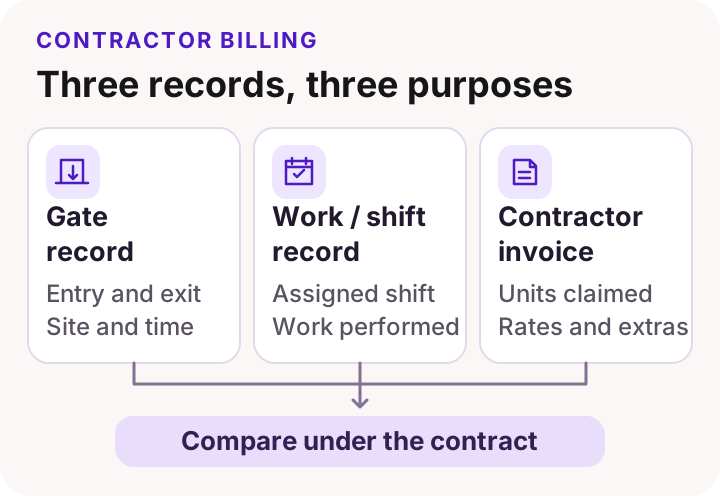
The records answer different questions. The same evidence-matching principle applies when reconciling material sent out for job work: a movement record is one piece of the evidence for what happened.
For example, an attendance record may establish that a worker was present.
But the site supervisor may still need to confirm whether the attendance belongs to an authorised, billable assignment.
Likewise, a contractor's invoice may include valid off-site assignments that are absent from the main gate register.
The objective is to identify the actual differences.
A worked example: 220 shifts billed, but only 198 appear in attendance
Consider a fictional company called Western Consumer Products Distribution Pvt Ltd.
The company operates a distribution warehouse supporting FMCG customers in Maharashtra.
It uses a manpower contractor for loading, packing and dispatch-support activities.
This is a hypothetical example, not a GreyBath client project.
For the reporting month, the contractor submits:
220 worker-shifts
The hypothetical agreement charges ₹900 per approved worker-shift, excluding applicable taxes and separately agreed adjustments.
For this example, assume each eligible worker-shift has the same agreed rate, and there is no separate minimum-guarantee provision affecting the calculation.
What the contractor submits
| Particular | Quantity |
|---|---|
| Worker-shifts claimed | 220 |
| Illustrative rate | ₹900 |
| Invoice value before taxes and adjustments | ₹1,98,000 |
The calculation is:
220 × ₹900 = ₹1,98,000
Accounts compares the claim with the available gate attendance.
Only 198 worker-shifts are initially supported by complete, matching on-site records.
The initial difference is:
220 − 198 = 22 worker-shifts
At this stage, the difference is not proof of overbilling.
It is a reconciliation exception.
What the investigation discovers
The contractor submits a worker-wise statement identifying the disputed entries.
The operations supervisor reviews the relevant dates and assignments.
The investigation finds three categories.
Eight shifts had incomplete attendance records
Eight workers had performed authorised shifts, but the original gate or attendance records were incomplete.
The company verifies the assignments using suitable supporting evidence.
The authorised supervisor approves the corrections according to the company's procedure.
These eight shifts become supported entries.
Six shifts were performed at another authorised location
Some contractor employees had been assigned to the company's secondary storage location.
They did not enter through the main warehouse gate.
However, the relevant site supervisor confirms the authorised assignments and completed work.
Under the hypothetical agreement, these assignments are eligible for the same per-shift charge.
Therefore, six additional shifts can be supported.
Eight shifts remain unsubstantiated
The remaining eight claimed shifts cannot yet be matched with adequate evidence.
The contractor's statement does not establish the necessary assignment and attendance or service position.
The company asks for further clarification.
These entries remain unresolved.
The reconciled position
| Category | Worker-shifts |
|---|---|
| Verified through original on-site attendance | 198 |
| Supported through approved attendance corrections | 8 |
| Supported through approved off-site assignments | 6 |
| Total supported under the example's billing rules | 212 |
| Still requiring evidence or resolution | 8 |
| Total originally claimed | 220 |
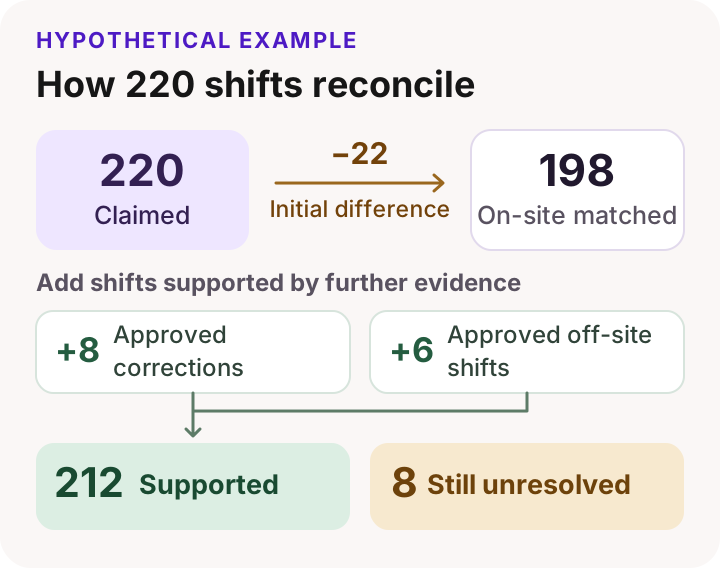
The calculation is:
198 + 8 + 6 = 212 supported worker-shifts
220 − 212 = 8 worker-shifts still requiring resolution
The initial difference of 22 has been reduced to eight after reviewing additional evidence.
The company should not automatically approve those eight claims.
It should also not automatically label them fraudulent.
The correct status is unresolved until the necessary review is complete.
What does the difference mean financially?
Using the fictional agreed rate of ₹900 per worker-shift:
Originally claimed:
220 × ₹900 = ₹1,98,000
Currently supported:
212 × ₹900 = ₹1,90,800
Difference requiring commercial resolution:
8 × ₹900 = ₹7,200
| Particular | Illustrative amount |
|---|---|
| Contractor's original claim | ₹1,98,000 |
| Supported service value | ₹1,90,800 |
| Amount currently in question | ₹7,200 |
For scale, suppose 15 contractors each have the same ₹7,200 unresolved amount every month for a year. At ₹7,200 × 15 × 12, the cumulative value requiring review would be ₹12,96,000 (₹12.96 lakh). This is a hypothetical annual total of claims requiring a decision. It does not estimate losses, savings or overbilling.
The contractor may provide additional acceptable evidence.
The commercial agreement may contain provisions requiring a different treatment.
There may be authorised adjustments.
The final invoice decision must follow the applicable contractual terms and approval process.
Why the distinction matters
If Accounts had approved only the 198 original gate entries, it might have rejected 14 valid shifts.
If it had approved all 220 without investigation, it would have accepted eight entries that were not adequately supported at that stage.
Both approaches could be wrong.
A dependable process identifies the supported position before making a commercial decision.
Do not assume a missed attendance entry means the employee was absent
Attendance systems can contain incomplete information.
For example:
A worker may forget to check out.
A device may be unavailable.
The system may fail to synchronise a record.
An authorised shift assignment may have been changed.
A supervisor may have approved work at another location.
Such situations require review.
They do not automatically establish attendance or absence.
Use controlled attendance corrections
Zoho People's official documentation describes attendance regularisation requests that allow incorrect or incomplete entries to be corrected, with approval where the organisation has configured an approval workflow.
The platform also maintains attendance audit history, including relevant changes and regularisation entries. Zoho Corporation
The important principle is applicable even if the company uses another system.
An attendance correction should identify the original entry, reason for correction, supporting evidence, approving authority and resulting record.
Do not overwrite original evidence silently
Suppose the original record shows an incomplete checkout.
After review, the supervisor confirms an authorised full shift.
The system should preserve the fact that a correction was made.
It should not erase the original record and make it appear that the corrected entry was captured automatically.
Controlled corrections make later investigation possible.
An edited spreadsheet with no change history provides less assurance.
Common attendance mismatches: overnight shifts and duplicate punches
Connect attendance to the intended shift
A shift starting at 10:00 PM on the 14th and ending at 6:00 AM on the 15th can appear as two incomplete records in a calendar-day export. Match both punches to the rostered shift and check overlapping entries and approved overtime. Zoho People’s shift settings describe how overnight records can be assigned to the correct shift date. Check the configuration against your roster.
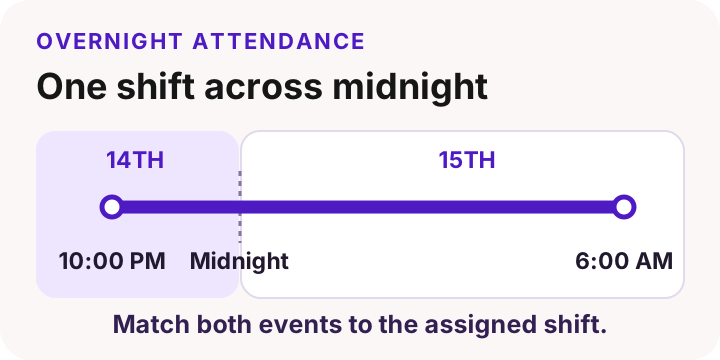
Do not double-count workers using multiple gates
Match entry at Gate A and exit at Gate B to the same worker and shift. Apply the same check to duplicate biometric punches before counting billable units.
Match workers to the actual assignment
“R. Kumar” on the contractor’s statement, “Raj Kumar” in the gate register and “Rajesh K.” in the supervisor’s log may refer to different people. Verify the match before merging any records.
Use a consistent worker reference
Match an authorised contractor-specific worker reference with the assigned site, shift and relevant access status. Restrict access to sensitive data. Avoid using Aadhaar numbers or other sensitive identifiers as ordinary spreadsheet keys unless there is a lawful and necessary basis.
Record approved substitutions
If the contractor sends a replacement, record who attended and which assignment they covered. Check the substitution against the contract and site requirements.
A planned roster is not proof that all shifts were worked
Suppose the contractor was asked to provide ten workers for 22 shifts.
The planned requirement is:
10 × 22 = 220 worker-shifts
That explains how the original number may have been calculated.
But the planned roster does not independently establish that every shift was performed.
A worker may be absent.
The company may cancel a shift.
The contractor may provide a replacement.
An approved off-site assignment may be added.
The contract may also guarantee payment for a minimum staffing commitment even where actual attendance differs.
These situations need different treatment.
Keep planned and actual records separate
Planned requirement: What the company scheduled or requested.
Actual attendance: What the available records show.
Verified work or service: What is supported under the agreed operating process.
Billable quantity: What the contract and authorised commercial review establish.
The billable quantity may match actual attendance.
But that should be a conclusion based on the agreement, not an automatic assumption.
Overtime needs its own approval
A contractor's invoice may include overtime.
For example, the normal shift may cover eight authorised working hours.
A worker may remain longer because dispatch volume increased.
The contractor may submit additional charges.
The company needs to verify whether those hours were actually worked, authorised and chargeable under the agreement.
Presence alone does not establish approved overtime
A worker may remain on the premises after the scheduled shift for several reasons.
The business should follow the agreed approval and time-recording process.
An attendance machine may record the additional time.
That does not automatically establish the correct overtime charge.
Similarly, the company should not ignore genuine additional work merely because an approval was delayed or recorded incorrectly.
An authorised review is needed.
The applicable wage and working-time obligations must be assessed independently.
A contractor's commercial overtime claim and an individual worker's legal wage entitlement are not necessarily the same calculation.
Never confuse contractor invoice verification with workers' wages
This distinction deserves particular attention.
The manufacturer receives a commercial invoice from the contractor.
The contractor may also have separate employment, payroll and statutory responsibilities toward its workers.
A discrepancy in the commercial invoice does not automatically authorise withholding workers' wages or reducing statutory entitlements.
The relevant employment and contractual obligations require separate assessment.
India's four Labour Codes came into effect on 21 November 2025, and the Ministry of Labour and Employment maintains subsequent rules and notifications. Companies should verify which provisions and state-specific requirements apply to their arrangements. official commencement announcement
Keep three decisions distinct
Contractor service verification: What services were provided and supported by evidence?
Commercial invoice approval: What is payable under the agreed contract?
Worker entitlement compliance: What wages, benefits and statutory obligations apply to the workers?
A software application may support records and approval workflows.
It should not automatically make legal determinations about wages or entitlements from a contractor billing discrepancy.
For material compliance questions, obtain qualified HR, payroll and legal advice.
A contractor can provide valid work outside the factory gate
Consider a distribution company operating two warehouses.
The main facility has an attendance terminal.
The second warehouse uses a supervisor-maintained register.
A contractor sends workers to both locations.
If Accounts reviews only the main facility's biometric attendance, the report may omit genuine assignments at the second location.
This is why the correct data scope matters.
Establish which locations belong to the contract
The company should identify the authorised locations and service assignments.
For each relevant shift or job, the record may need the site, date, worker reference, contracted service and approving person.
Where an assignment occurs away from the normal site, retain appropriate evidence.
The amount of evidence should be proportionate.
A small packing operation does not necessarily require an elaborate GPS-based workforce-monitoring system.
The right approach may be a signed site register or approved digital attendance record.
Do not introduce intrusive tracking without a clear need
Biometric attendance, location monitoring and worker photographs can create privacy, security and administrative obligations.
The company should assess necessity, lawful processing, access restrictions, retention and suitable alternatives before introducing such tools.
A controlled paper register or existing authorised attendance system may already solve the business problem.
Build one controlled contractor reconciliation register
A small business can begin with a spreadsheet linked to its existing attendance and accounting records.
The register should not replace the official HR, attendance or accounting systems.
Its purpose is to document the reconciliation decision.
Suggested contractor-invoice reconciliation template
| Field | Example |
|---|---|
| Contractor reference | CT-014 |
| Contractor invoice | INV-2026-118 |
| Reporting period | October 2026 |
| Contract or work-order reference | WO-092 |
| Billing basis | Approved worker-shift |
| Contractor's claimed quantity | 220 |
| Verified on-site shifts | 198 |
| Approved attendance corrections | 8 |
| Approved off-site assignments | 6 |
| Supported quantity | 212 |
| Quantity requiring resolution | 8 |
| Agreed illustrative rate | ₹900 per shift |
| Supported service value | ₹1,90,800 |
| Amount requiring resolution | ₹7,200 |
| Exception owner | Operations manager |
| Commercial review | Pending |
| Final invoice approval | Not yet completed |
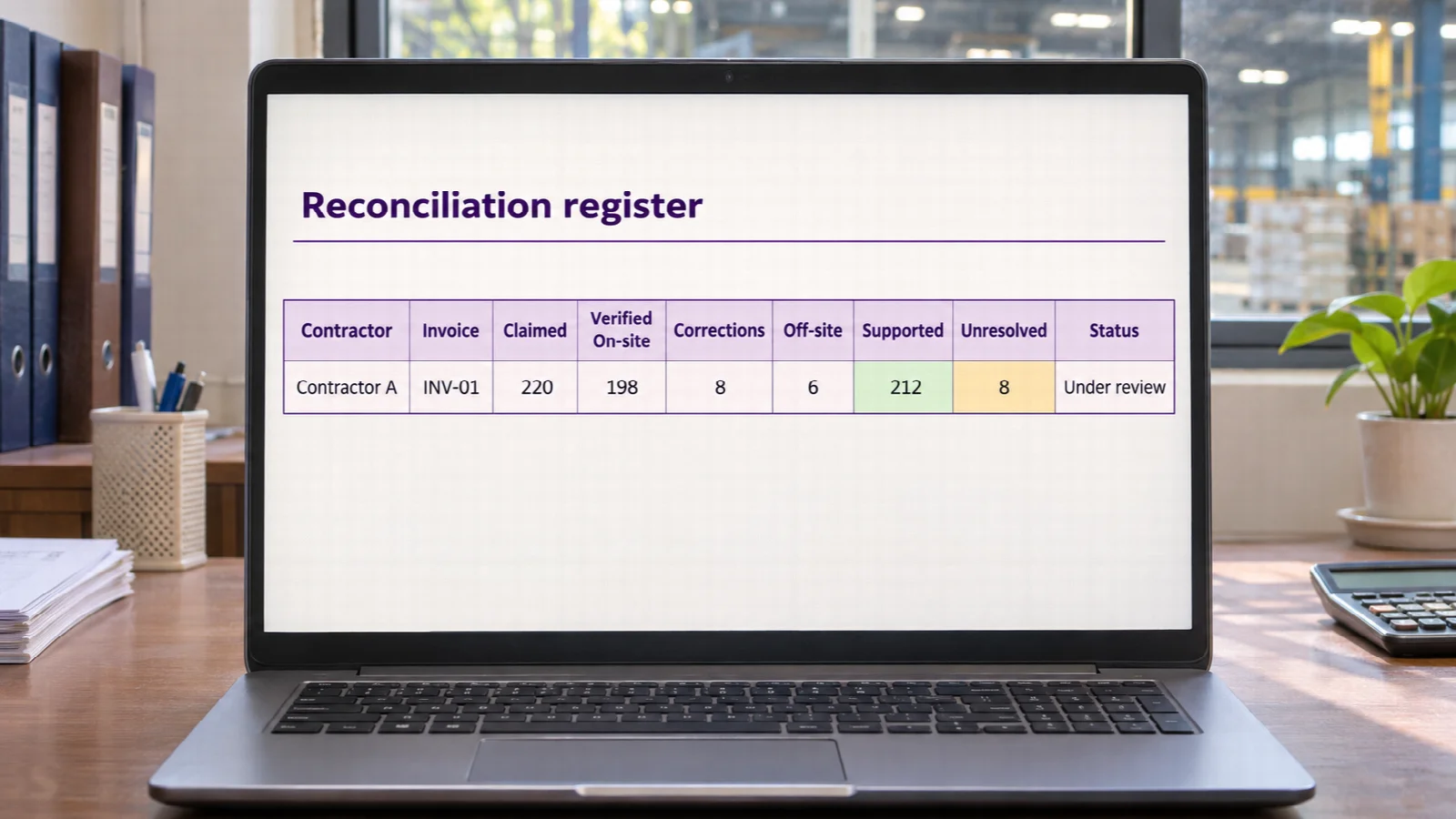
All figures and references are hypothetical.
Preserve supporting evidence
The register should link to the relevant attendance report, supervisor approval, contractor statement and invoice.
Do not copy confidential worker records into unrestricted spreadsheets.
The business should control who can view, edit and approve the information.
Where the contractor disputes a finding, the exception should remain visible until the authorised review is completed.
Make the exception more useful than “Attendance mismatch”
A useful exception record explains the actual problem.
For example:
| Exception | What needs investigation |
|---|---|
| Missing punch | Whether an authorised shift occurred despite incomplete capture |
| Worker not identified | Whether the worker can be reliably matched to the approved assignment |
| Off-site work | Whether the alternate assignment was authorised and performed |
| Duplicate attendance | Whether multiple records describe one actual shift |
| Shift-date mismatch | Whether an overnight shift was attributed correctly |
| Overtime discrepancy | Whether additional hours were supported and authorised |
| Rate discrepancy | Whether the invoice used the applicable agreed commercial rate |
| Unsupported claim | Whether additional evidence is required before approval |
These categories distinguish record problems from commercial differences.
A person may have worked a valid shift even when the attendance record needs correction.
An attendance record may be correct while the contractor uses the wrong commercial rate.
The same approval action will not solve both problems.
Give the reconciliation a named owner
A common difficulty arises when several departments are involved.
Security maintains gate attendance.
Operations confirms work.
HR controls certain worker records.
Accounts receives the invoice.
Procurement or Administration manages the contractor agreement.
The contractor provides its own statement.
Each party may believe another department owns the discrepancy.
A practical responsibility model could be:
| Activity | Suggested owner |
|---|---|
| Confirm contracted service and billing basis | Procurement or Administration |
| Maintain original gate records | Security or authorised attendance administrator |
| Verify assigned work and exceptions | Site supervisor |
| Review worker-related attendance corrections | Authorised HR or time-office personnel |
| Submit contractor statement and evidence | Contractor representative |
| Calculate supported billing quantity | Designated reconciliation owner |
| Approve commercial exceptions | Authorised manager |
| Process invoice | Accounts |
| Review legal and statutory obligations | Qualified HR, payroll or legal personnel |
Operations confirms the work and Accounts verifies rates and amounts against the agreement. The manager or joint sign-off named in the approval policy makes the final commercial call. Accounts then processes the authorised amount.
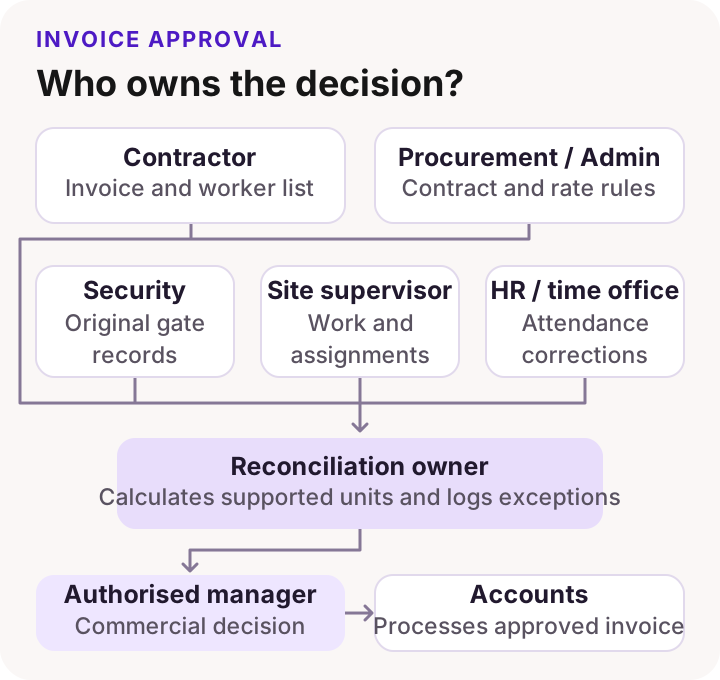
A small SME may combine some of these responsibilities.
The important control is that the original records, corrections and commercial approvals remain distinguishable.
A small contractor may not need specialised software
Consider a factory using one manpower contractor.
The contractor supplies a manageable number of workers.
All workers attend one location.
The monthly bill is straightforward.
Attendance exceptions are rare.
The company may already have everything it needs.
It can maintain an approved roster, review the available attendance records, verify unusual entries and reconcile the invoice.
A controlled spreadsheet may be sufficient.
Start with the existing process
For a first improvement, the company can agree that the contractor provides a worker-wise monthly statement using the same identifiers and reporting period as the factory.
The supervisor reviews exceptions.
Accounts receives the supported quantity and commercial approval.
This can work without commissioning another application.
Do not buy biometric hardware simply to solve an invoice problem
If the main issue is that no supervisor approves off-site assignments, a new biometric machine at the main gate will not resolve it.
If the issue is incorrect overnight shift calculation, the existing attendance software may need configuration.
If the issue is a fixed-fee contract with unclear service obligations, the business may need to clarify the agreement.
The technology decision should follow the confirmed problem.
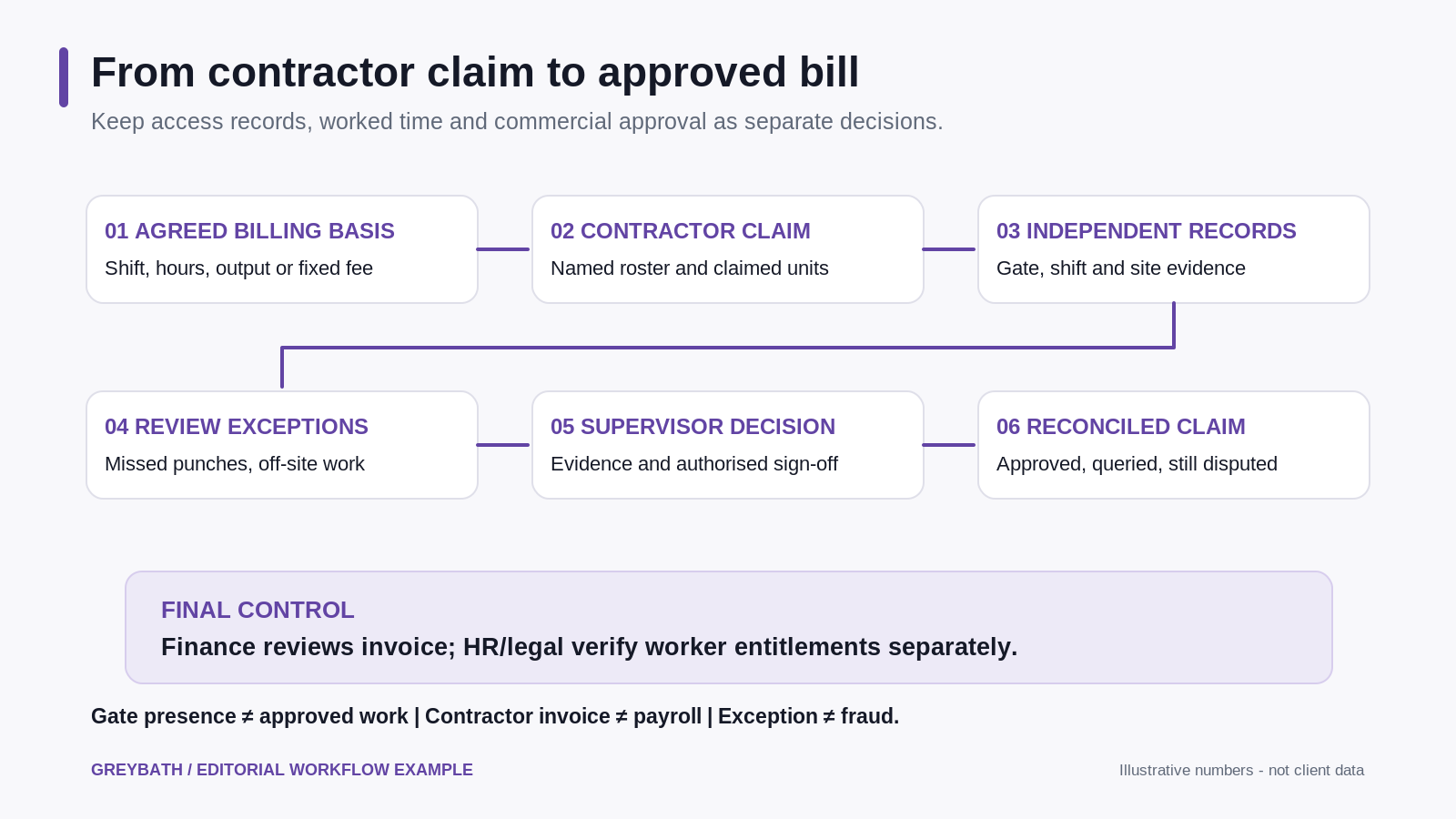
Owner-supplied 2D educational workflow; it is not a screenshot of a client attendance system.
Your existing attendance software may already support most of the work
Many HR and workforce platforms provide attendance, shifts, approvals and reporting.
Zoho People, for example, documents attendance views, corrections, on-duty requests, shift configuration and audit histories.
Zoho Shifts documents manager timesheet approvals and authorised finalisation of relevant time records. Zoho Shifts timesheet review
These features may reduce manual work.
However, a company should verify the exact edition and configuration being used.
Check what already exists
The business may already be able to export worker-wise attendance, assign shifts, record approved corrections and obtain supervisor approval.
The remaining task may be a controlled commercial comparison with the contractor's statement.
An existing SaaS or ERP feature may be sufficient.
Where another system becomes useful
A more connected workflow becomes relevant when:
Several contractors work at the same site.
Workers operate across multiple locations.
The company regularly receives incomplete attendance records.
Different supervisors approve shifts and overtime.
Contractor invoices use different billing arrangements.
Accounts repeatedly requires manual clarification.
Management cannot easily see unresolved exceptions before payment approval.
In these circumstances, a controlled reconciliation workflow may reduce coordination difficulties.
But it should not duplicate the original attendance or financial records without a clear reason.
Automate comparison, not unsupported conclusions
A company may want a system that automatically compares contractor invoices with attendance.
That can be useful when the records are structured and the billing rules are clear.
For example, software could identify:
Contractor claim: 220 worker-shifts
Supported records: 212 worker-shifts
Difference requiring review: 8 worker-shifts
The application could assign those eight entries to an authorised reviewer.
But it should not automatically conclude that the contractor has overcharged.
Use transparent matching rules
A practical system might compare the worker reference, contractor, date, assigned shift, location, supporting attendance and approved exceptions.
Where a record matches the agreed rules, it can proceed to the appropriate review stage.
Where the records conflict, the application can identify the reason.
The employee responsible for the decision should be able to see the supporting evidence.
AI is not required for every contractor invoice
If the invoice and attendance data are already available in spreadsheets or databases, ordinary comparison rules may be sufficient.
AI-assisted document extraction could be considered when contractor statements arrive in inconsistent formats.
However, extracted worker references, dates and quantities would still require validation.
AI cannot independently establish that an unrecorded shift was worked.
It should not invent attendance evidence or make unsupported accusations.
Keep the original attendance and invoice records intact
Suppose a contractor submits 220 worker-shifts.
The company identifies eight entries requiring correction.
The contractor later submits a revised statement.
The new statement may be legitimate.
But the company should preserve the original claim and the basis of the change.
Otherwise, management may be unable to understand why the invoice value changed.
A useful record contains a history
The process should identify:
Original claim.
Initial verification result.
Exceptions identified.
Evidence submitted.
Authorised decisions.
Final approved commercial position.
The original attendance data should not be silently overwritten.
Similarly, a revised contractor statement should not erase the previous submission.
This helps both parties understand how the final amount was established.
An audit trail is useful because it preserves accountability.
It does not prove that every original or revised entry is correct.
Measure reconciliation quality, not the number of disputes
A factory can begin with a small set of useful measures.
Contractor claims requiring clarification
Track the quantity or value of submitted claims that initially differ from the available records.
For the hypothetical example:
22 of 220 worker-shifts initially required clarification.
That is:
22 ÷ 220 × 100 = 10%
This figure is a hypothetical initial exception rate.
It does not represent an overbilling rate.
Exceptions resolved through supporting evidence
Track how many exceptions were resolved after authorised review.
In the example, 14 of the initial 22 exceptions were supported through additional evidence.
Eight remain unresolved.
That helps management understand whether the difficulty arises from missing records, incomplete processes or genuine commercial disagreement.
Unresolved claim value
Record the value requiring a decision.
In the example, ₹7,200 remains under review.
Do not automatically call it money saved.
Attendance corrections by reason
Track recurring missed punches, incorrect shift assignments or off-site recording problems.
The objective is to reduce avoidable errors.
It is not to discourage employees from requesting legitimate corrections.
Invoice approval delays
Measure how long contractor invoices remain pending because required evidence or decisions are unavailable.
A process should improve reliability without creating unnecessary delays.
Differences between approved and paid values
Review cases where the approved commercial amount and the processed invoice or payment do not match.
These may indicate an accounting or workflow issue rather than an attendance problem.
When the contractor disputes the final calculation
An unresolved difference should have a documented review route.
Consider the eight remaining shifts in the fictional example.
The contractor may provide additional evidence.
The company may identify missing records.
The parties may disagree about how the contract applies.
The responsible manager should review the position under the agreed process.
Do not automatically accuse the contractor of fraud
An unexplained entry is not proof of deliberate misconduct.
A mismatch may result from incorrect identifiers, data errors, different reporting periods or a genuine contractual disagreement.
Where wrongdoing is suspected, preserve the evidence and follow the appropriate investigation and legal process.
Do not change worker attendance merely to settle the invoice
The company should not alter genuine attendance records to force the contractor's claim to match a preferred commercial result.
Likewise, it should not alter valid records to reduce an invoice.
Correct data and commercial approval are separate responsibilities.
The final decision should be supported by the applicable records and contractual terms.
When this approach needs to change
Not every outsourced service should be reconciled through worker-shifts.
A housekeeping contract may specify a fixed monthly fee with service-level obligations.
A loading contractor may charge per truck or tonne handled.
A security-services agreement may contain different staffing, relief and commercial provisions.
A construction-related contractor may operate under an entirely different service and workforce arrangement.
Some contracts contain minimum staffing commitments, permitted substitutions or special charging rules.
These must be considered before making deductions.
Additional legal and operational requirements may apply
Contractor arrangements can involve employment, health and safety, site-access, insurance, wage and social-security obligations.
These require separate review.
India's labour-law framework has undergone significant changes, and applicability may depend on current central and state requirements.
A generic contractor-attendance dashboard should not be presented as evidence of complete labour-law compliance.
The same applies to privacy.
Collect only the worker information necessary for the approved purpose, restrict access and apply appropriate security and retention controls.
The management decision
When the contractor submits a bill, Accounts should not approve it merely because the total looks similar to last month.
But management should also avoid rejecting every entry that does not appear in the gate register.
The company needs to know:
What service was agreed?
What billing unit applies?
Which assignments were authorised?
What do the original attendance records show?
Which differences have valid supporting evidence?
Which entries remain unresolved?
Who can approve the commercial outcome?
Start with the existing contractor agreement.
Review the actual attendance and service records.
Correct verified recording problems.
Maintain a controlled exception register.
Assign responsibility.
Then approve or resolve the commercial invoice according to the agreement.
For a small operation, existing software and a spreadsheet may be sufficient.
For a larger SME with several contractors and sites, a connected workflow may become worthwhile.
The important objective is not to produce more attendance reports.
It is to make the relationship between authorised work and contractor billing understandable.
A contractor's invoice is a commercial claim. A gate record is attendance evidence. The approved amount must follow the applicable contract and properly verified information.
Where GreyBath can contribute
A controlled spreadsheet or your current HRMS may be enough for a single site. When several sites or contractors create repeated manual handoffs, GreyBath can connect authorised attendance exports, contractor statements and supervisor approvals in one review workflow. Start with agreed billing rules, permissions and named approvers.
Explore ERP, CRM, Portals & Dashboards or Custom Web Applications & Integrations.
Sources reviewed
The operational recommendations and product examples above were checked against these primary or official sources. Product features, legal duties and filing requirements can change; verify current applicability before implementation.
Keep reading
More practical thinking from GreyBath across design, engineering and growth.
All articles