

The Customer Sent a Purchase Order, but the Price Doesn't Match Your Latest Quotation
A practical guide to quotation version control, customer purchase-order comparison and commercial approval before order release.

Share this article
Browse all insightsA packaging-material manufacturer receives an enquiry from a regular customer.
Cover disclosure: the cover is an AI-generated editorial illustration. The people, organisation, records and situation are fictional and do not depict a GreyBath client.
The customer needs 5,000 units of a particular packaging product.
Sales prepares a quotation and emails it to the customer.
A few days later, material costs change.
The sales manager reviews the price and sends a revised quotation.
The customer acknowledges the email.
Another week passes.
The customer's purchase department finally issues a purchase order.
Your sales executive forwards the order to the factory.
Production begins planning the job.
But Accounts notices something.
The customer's purchase order contains the price from the first quotation, not the revised one.
Sales believes the latest quotation should apply.
The customer believes it has ordered against the earlier price.
Production is waiting for confirmation.
Accounts cannot determine which commercial terms should be used.
The business now has a dispute before the goods have even been manufactured.
For manufacturers, distributors, wholesalers and other B2B suppliers, this is a practical sales-operations problem.
It does not always happen because a salesperson entered the wrong price.
Sometimes the company has several genuine quotations, but no controlled process for establishing which version the customer accepted.
The important question is not simply which quotation was sent last. It is which commercial terms were actually agreed.
Why one customer enquiry can produce several quotations
B2B quotations frequently change during negotiation.
Consider a manufacturer supplying industrial components.
The first quotation may cover 1,000 units.
The customer later increases the quantity to 2,500.
Sales revises the price.
The customer asks for delivery to another location.
Freight changes.
The customer then requests 60-day credit instead of the original 30-day terms.
Management approves a revised commercial arrangement.
During this process, the customer may receive several PDFs.
The salesperson may also communicate revised prices through email or WhatsApp.
By the time the customer issues a purchase order, the business may have multiple versions of the same commercial offer.
The problem is not creating revisions
Revisions are a normal part of B2B sales.
The problem begins when the versions are not clearly identified.
For example:
Quotation_Final.pdf
Quotation_Final_New.pdf
Quotation_Updated.pdf
Quotation_Latest_Final.pdf
These filenames may make sense to the employee who created them.
They do not establish a dependable commercial history.
A new employee, accounts executive or production planner may not know which document should be used.
The company needs a reference that does not depend on somebody remembering the email conversation.
Every issued quotation needs an identifiable version
Imagine a company creating a quotation with reference:
QT-2026-208
The first issued version can be:
QT-2026-208-R0
After a commercial revision:
QT-2026-208-R1
If the customer requests another change:
QT-2026-208-R2
The exact numbering format is not important.
What matters is that each issued version can be identified separately.
What should be preserved?
For every quotation sent to the customer, the business should retain:
| Information | Example |
|---|---|
| Quotation reference | QT-2026-208 |
| Revision | R1 |
| Customer | ABC Industrial Packaging |
| Issue date | 14 October 2026 |
| Item and specification | Approved product reference |
| Quantity | 5,000 units |
| Unit price | ₹138 |
| Quotation validity | As stated in the issued terms |
| Payment terms | As approved |
| Delivery conditions | As stated |
| Prepared by | Sales executive |
| Internal approval | Commercial manager |
| Customer communication | Email or approved communication reference |
| Current internal status | Issued; customer confirmation pending |
This is a suggested internal record.
It does not need to be maintained in a separate application if the existing CRM or ERP already supports quotation revisions.
Do not overwrite the original issued document
Suppose Sales sends a quotation for ₹132 per unit.
Later, the employee opens the same file, changes the amount to ₹138 and saves it using the original filename.
The original issued version may no longer be available.
That can make it difficult to understand what the customer actually received.
Microsoft Dynamics 365 Sales addresses this type of version control by making activated quotations read-only and assigning revision identifiers when they are revised. Its documentation describes the process from quotation through sales order and invoice.
The underlying principle can be applied without Microsoft software.
Preserve what was issued. Create a new identifiable version when the offer changes.
A newer quotation is not automatically an agreed quotation
This distinction is important.
Suppose your company sends a revised quotation on Monday.
Your salesperson writes:
Revised quotation attached with updated pricing.
The customer does not respond to the revised commercial terms.
On Friday, the customer sends a purchase order referencing the earlier quotation.
Can your company automatically assume that the revised price applies because it was sent later?
No.
Sending a revised offer does not, by itself, establish that the buyer agreed to it.
The actual position depends on the communications, quotation terms, purchase order, any existing contract and applicable law.
Similarly, marking an earlier quotation as superseded inside your CRM does not necessarily establish that the customer's rights or an existing contractual commitment have changed.
Separate three facts
Latest internal quotation: The version your company most recently prepared or issued.
Customer-referenced quotation: The version identified by the buyer in its purchase order or acceptance.
Agreed commercial terms: The terms actually established through the relevant acceptance, negotiation and contractual process.
These facts may match.
But they should not be treated as identical without verification.
For ordinary order processing, your team should be able to identify all three.
For a material contractual disagreement, seek appropriate commercial or legal advice rather than relying on a software status.
A worked example: the difference between ₹132 and ₹138 per unit
Consider a fictional company called Konkan Flexible Packaging Pvt Ltd.
The company manufactures packaging material for FMCG customers.
This is a hypothetical example, not a GreyBath client project.
A customer requests 5,000 units of a particular packaging product.
First quotation
On 6 October 2026, Sales issues:
Quotation: QT-2026-208-R0
Quantity: 5,000 units
Price: ₹132 per unit
Quotation value: ₹6,60,000
For the illustration, assume the quotation specifies validity until 31 October 2026, subject to its other stated conditions.
Revised quotation
On 14 October 2026, the company reviews its material costs.
The commercial manager authorises a revised offer.
Sales issues:
Quotation: QT-2026-208-R1
Quantity: 5,000 units
Price: ₹138 per unit
Quotation value: ₹6,90,000
The revised quotation is sent to the customer.
However, the company has no clear record showing that the customer accepted the revised price.
The customer purchase order
On 21 October 2026, the customer sends its purchase order.
The purchase order references:
QT-2026-208-R0
The unit price is ₹132.
The order quantity is 5,000 units.
Now the manufacturer has two different commercial positions.
| Item | Earlier quotation R0 | Revised quotation R1 |
|---|---|---|
| Issue date | 6 Oct 2026 | 14 Oct 2026 |
| Quantity | 5,000 units | 5,000 units |
| Unit price | ₹132 | ₹138 |
| Total before taxes and other adjustments | ₹6,60,000 | ₹6,90,000 |
| Customer PO reference | Yes | No confirmed acceptance recorded |
The difference is:
₹6,90,000 − ₹6,60,000 = ₹30,000
This is a hypothetical quotation-value difference.
It is not an established financial loss.
The company still needs to determine which terms apply.
How the price difference affects the commercial calculation
For illustration, assume the company's relevant unit cost is ₹120.
Also assume there are no other differences between the quotations and ignore taxes, freight, overhead allocation and other adjustments.
At ₹132 per unit:
Illustrative unit contribution = ₹132 − ₹120 = ₹12
For 5,000 units:
₹12 × 5,000 = ₹60,000
At ₹138 per unit:
Illustrative unit contribution = ₹138 − ₹120 = ₹18
For 5,000 units:
₹18 × 5,000 = ₹90,000
The difference in this simplified contribution calculation is ₹30,000.
| Calculation | At ₹132 | At ₹138 |
|---|---|---|
| Revenue | ₹6,60,000 | ₹6,90,000 |
| Assumed relevant costs | ₹6,00,000 | ₹6,00,000 |
| Illustrative contribution | ₹60,000 | ₹90,000 |
These figures are hypothetical and do not represent accounting profit.
The calculation shows why quotation versions matter commercially.
A relatively small change in selling price can materially affect the contribution remaining after the assumed costs.
But the manufacturer cannot automatically claim that it has lost ₹30,000.
If the earlier terms are binding, the business may need to honour them.
If no agreement has been established, the parties may need to clarify the commercial position before proceeding.
The purpose of the comparison is to identify the difference before accepting or fulfilling the order—not to automatically impose the newer price.
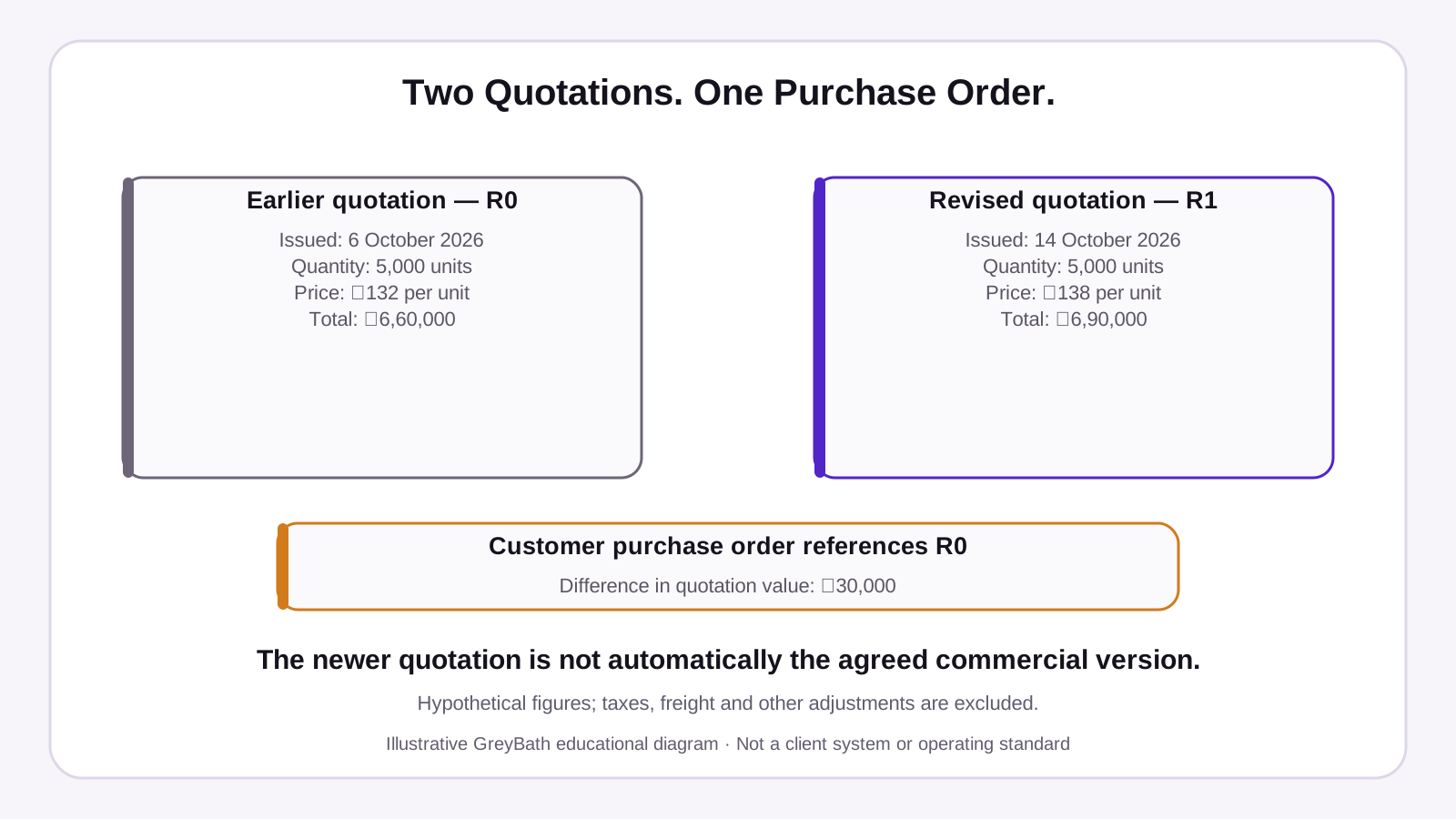
Original GreyBath 2D educational diagram recreated from the owner-supplied visual specification. Figures and examples are illustrative.
What should Sales do when the PO references the older quotation?
The first response should not be to change the customer's purchase order internally.
The customer issued that document.
Your company should preserve it as received.
The sales executive should identify the discrepancy and review the actual commercial history.
Establish the relevant documents
Retrieve the original quotation, revised quotation, customer communications, purchase order and any relevant contract.
Check whether the earlier offer was valid when the buyer responded.
Review what the parties communicated about the revision and whether any acceptance was confirmed.
Do not assume that the expiry date or an internal superseded label automatically resolves every contractual question.
Identify the specific mismatch
In this example, the quantity and item are unchanged.
Only the price differs.
That makes the issue easier to isolate.
For another order, several conditions may differ.
Obtain the appropriate commercial decision
The authorised manager may decide to honour the earlier price, negotiate the revised price or take another action consistent with the agreement and applicable obligations.
If the parties agree to changed terms, obtain the appropriate documented confirmation.
The customer may need to issue a revised purchase order, or the parties may use another contractually acceptable method of recording the agreed change.
Release the order only after the uncertainty is addressed
Once the agreed commercial position is established, the authorised order-processing team can create or confirm the sales order.
The sales order should reflect the terms accepted under the company's process.
If production or dispatch has already started, management must also address any resulting operational commitments.
A quotation mismatch should not be hidden merely to keep the order moving.
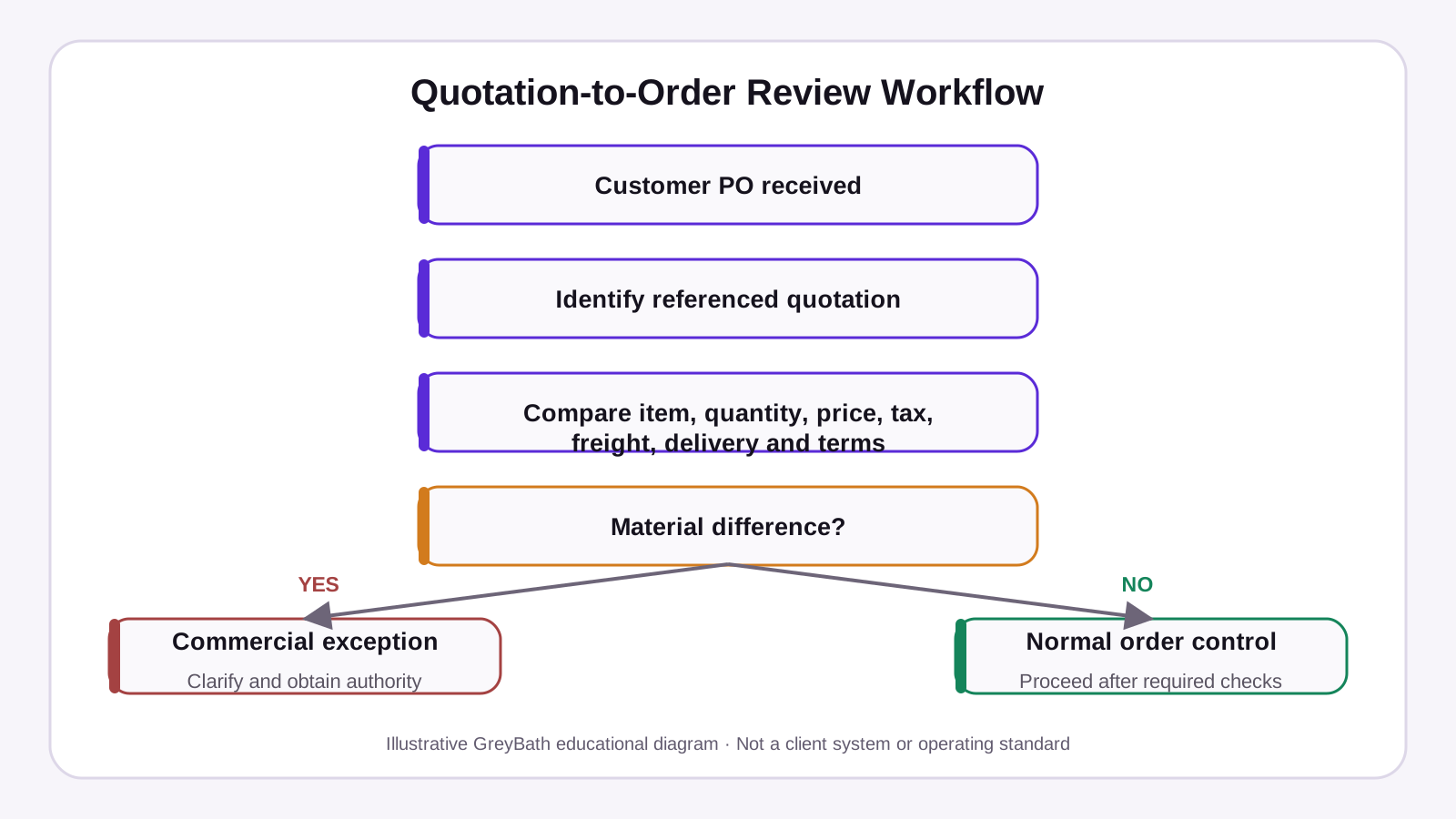
Original GreyBath 2D educational diagram recreated from the owner-supplied visual specification. Figures and examples are illustrative.
Price is not the only detail that must match
Consider a customer purchase order that references the correct quotation number.
The price also matches.
Can Sales immediately accept it?
Not necessarily.
The customer may have changed the quantity.
The delivery destination may differ.
The purchase order may introduce additional payment conditions.
The item description may not match the approved specification.
For B2B suppliers, these differences can be commercially important.
A practical quotation-to-PO comparison
| Field | What to verify |
|---|---|
| Customer identity | Correct legal purchasing entity and relevant branch |
| Quotation reference | Exact quotation and revision identified |
| Item specification | Correct item code, grade, dimensions or approved specification |
| Quantity and unit | Same quantity and unit of measurement, or an approved change |
| Unit price and currency | Agreed commercial rate |
| Taxes and freight | Appropriate treatment under the agreed terms |
| Payment terms | Approved credit period, advance or other conditions |
| Delivery requirements | Destination, schedule and agreed obligations |
| Other commercial conditions | Any material warranty, inspection, penalty or contractual changes |
Not every order requires the same level of review.
A standard repeat order may need only a straightforward comparison.
A custom manufacturing order may require detailed technical and commercial checks.
The purpose is to identify differences before the supplier becomes committed to delivering something it has not properly agreed to supply.
A customer PO should not automatically become a confirmed sales order
Many SMEs treat the receipt of a customer purchase order as a signal to begin production or dispatch.
That may be appropriate for routine orders under an established agreement.
But it can be risky when the purchase order differs from the accepted quotation or agreed terms.
The business needs a distinction between:
Customer purchase order received
and
Supplier order accepted for fulfilment
The precise contractual consequences depend on the transaction and applicable agreement.
Operationally, however, the business should know whether an order has passed its required internal checks.
Zoho Books documents a quotation-to-sales-order process in which an accepted quotation can be converted into a sales order, with the details reviewed before the sales order is saved and sent.
For a small business, this principle can be applied manually.
A purchase order can enter the system as received and awaiting review.
It should not automatically become a production instruction where material discrepancies remain unresolved.
Create an exception process rather than approving every routine order twice
Not every quotation requires multiple senior-level approvals.
That would slow normal business.
The better approach is to define which situations require additional review.
For example, a sales manager may need to approve:
A selling price below the authorised price range.
An unusual discount.
A change in approved credit terms.
A custom product specification.
A commitment outside normal delivery capability.
A material difference between the customer PO and the agreed quotation.
These are suggested exception categories.
The company should define its actual approval limits based on its business model and internal authority structure.
Avoid approving only the total quotation value
Suppose a quotation contains ten items.
Nine items are priced correctly.
One item is significantly underpriced.
The total quotation value may still look acceptable.
A useful approval process should identify the relevant line-level exception.
Similarly, a customer may reduce a quotation's quantity but expect the same bulk-discount rate.
The total amount becomes smaller, but the unit economics may have changed.
A business should define when quantity changes require repricing or approval.
Odoo's official pricelist documentation includes pricing rules based on customers, minimum quantities and validity periods. These are examples of controls that may already exist in a configured sales system.
Quotation validity needs a clear business rule
Many quotations include a statement such as:
Valid for 15 days.
That is useful.
But management also needs to define how staff should handle a purchase order received after the stated validity period.
Should Sales request a fresh price approval?
Can an authorised manager extend the offer?
Does the business need to issue another quotation?
Does an existing contract govern the order?
The answers depend on the commercial arrangement.
Do not confuse expiry with automatic cancellation of every obligation
An expired quotation may no longer represent a currently open offer under its terms.
However, an expiry label alone does not settle whether an agreement was already formed or whether a separate contract applies.
Where a binding commitment may exist, the business should follow its contractual obligations.
For ordinary internal control, the company can still require an authorised review before accepting an order against an expired quotation.
Odoo's quotation functionality supports configurable validity periods, including customer-specific quotation details.
The practical benefit is making the review requirement visible.
It is not creating a universal legal rule.
Preserve the accepted commercial version
Once a customer and supplier have agreed on the relevant terms, the business needs a reliable record of that agreement.
Avoid silently changing prices in accepted quotation records.
This is particularly important when the software permits edits after acceptance.
Zoho Books documents a setting that allows users to edit accepted quotations while retaining their Accepted status. That behaviour may be useful in some workflows, but it also means the status alone does not prove that the visible contents are identical to the document originally accepted.
A controlled process should preserve the appropriate issued and accepted records.
If a change is required after agreement, record it through an authorised amendment or revision process.
The original commercial history should remain understandable.
This can help Sales, Accounts and Operations work from the same agreed position.
Start with an issued-quotation register
A business does not need to develop custom software immediately.
For a small sales team, a controlled spreadsheet may be sufficient.
The register should identify each issued quotation version and its current commercial status.
Suggested quotation register
| Field | Example |
|---|---|
| Quotation reference | QT-2026-208 |
| Revision | R1 |
| Customer | ABC Industrial Packaging |
| Issue date | 14 October 2026 |
| Quoted amount | ₹6,90,000 |
| Validity | As per issued quotation |
| Sales owner | Assigned executive |
| Internal approval | Approved |
| Customer response | Revised terms not yet confirmed |
| Customer PO reference | PO-482 |
| PO comparison | Price mismatch |
| Next action owner | Sales manager |
| Order release position | Under commercial review |
This is an illustrative record.
Do not store confidential margins or sensitive customer information in an unrestricted spreadsheet.
The quotation files themselves should remain in a controlled business location.
The register should link to the relevant versions rather than becoming another place where employees independently change prices.
Keep issued and draft quotations separate
Drafts may change many times before they are sent.
Not every internal edit needs to become a customer-facing revision.
Once a quotation is formally issued, preserve that version.
If its commercial terms are subsequently revised and communicated to the customer, issue a separately identifiable version.
This keeps the working process manageable.
Decide who owns the mismatch
A common problem is that everybody can see the discrepancy, but nobody is responsible for resolving it.
Sales says Accounts should check the price.
Accounts says Sales prepared the quotation.
Operations says it received a confirmed-looking purchase order.
The factory wants to know whether production can begin.
A useful responsibility model could be:
| Activity | Responsible team |
|---|---|
| Prepare quotation | Sales |
| Validate technical specification | Authorised technical or product team |
| Approve commercial exceptions | Sales or commercial manager |
| Preserve issued quotation | Sales operations |
| Compare incoming PO | Order-processing team |
| Clarify differences with customer | Sales owner |
| Approve agreed exception | Authorised manager |
| Release accepted sales order | Order-processing or operations team |
| Preserve final commercial record | Recognised ERP/CRM record owner |
A small business may combine several of these responsibilities.
What matters is that discrepancies have a named owner and an agreed resolution process.
Do not edit the customer's purchase order to make it match
Suppose the customer PO contains ₹132.
Your internal system expects ₹138.
The order-processing employee manually enters ₹138 into the sales order and ignores the customer PO difference.
Now your sales order and customer PO disagree.
The problem may surface later during invoicing.
It may also create confusion during receipt or payment approval at the customer's end.
The right response is to resolve the difference through an authorised commercial process.
Do not alter the customer's original document.
Do not treat an internal price correction as proof of customer agreement.
If revised terms are accepted, preserve the supporting confirmation and link it to the transaction.
The same principle applies to specification or quantity changes.
A controlled record should explain what was changed, who approved it and what the customer agreed.
Customer acceptance should be visible to the whole order-processing team
In many small businesses, the salesperson knows the latest negotiation outcome.
But the information exists only in that employee's email or WhatsApp.
The order-processing team receives a PDF without the full context.
The company then depends on the salesperson being available to explain what happened.
That is fragile.
A better process records the relevant acceptance or commercial decision in the recognised system.
For example:
Customer PO received.
Mismatch identified.
Customer clarification requested.
Revised terms confirmed.
Authorised sales order released.
These are suggested operational states, not evidence of legal acceptance by themselves.
For Indian transactions, sections 3–10 of the Indian Contract Act, 1872 address communication, acceptance and revocation of proposals and the conditions under which agreements become contracts. How those provisions apply to a quotation, purchase order, email exchange or course of dealing is fact-specific; obtain appropriate legal advice for a disputed or material commitment.
The supporting communication or contract should remain accessible to authorised reviewers.
When an existing CRM or ERP is enough
Before building another quotation-management application, check the capabilities of your current software.
Microsoft Dynamics 365 Sales supports quotation revisions and distinguishes draft, active and revised quotation states.
Odoo supports quotation validity, pricelists, templates and sales-order confirmation.
Zoho Books supports accepted quotations and conversion to sales orders.
Your current software may already be able to manage most of the workflow.
The first project may simply be configuring the existing quotation process, permissions and approval rules.
When a spreadsheet is sufficient
A controlled register can work for a small team issuing relatively few quotations.
It must be maintained consistently.
Issued PDFs, customer responses and approval records should remain accessible.
When a dedicated SaaS tool may be suitable
If quotation volume is high or the business handles complicated configurations, an existing quotation or sales-automation platform may provide suitable features.
Evaluate the actual requirements and subscription costs before choosing.
When custom integration becomes relevant
A connected workflow may be worthwhile when:
CRM contains customer enquiries and sales ownership.
ERP contains products, stock and approved prices.
Sales employees generate quotation revisions.
Customers send purchase orders.
Operations creates sales orders and plans fulfilment.
Management needs visibility into commercial exceptions.
The objective would be to connect these records rather than force employees to compare everything manually.
However, implementation feasibility depends on supported APIs, data access, permissions and the quality of the existing records.
Do not start with automatic PDF reading
A business may ask for AI to read customer purchase orders and compare them with quotations.
That can be a potential use case.
But the first problem is often not document extraction.
It is the absence of reliable quotation versions and approved commercial rules.
Suppose AI accurately reads:
PO price: ₹132
Latest quotation price: ₹138
The system can identify a difference.
It still cannot independently determine whether the older quotation remains binding or which commercial exception management should approve.
Likewise, OCR or AI document extraction may misread product codes, quantities or tables.
If a business introduces automated document comparison, it needs appropriate validation and human review for significant discrepancies.
Start with structured information
Where practical, store the quotation's important commercial fields in the system that issued it.
Preserve the original customer PO.
Compare the two.
Flag differences.
Assign a responsible person.
Only after the process works should the business consider whether document extraction would reduce enough manual effort to justify its cost and maintenance.
AI can help identify differences. It should not silently decide disputed commercial terms.
Measure mismatches before measuring automation
A useful quotation process should reduce commercial uncertainty and unnecessary rework.
Management can start with a few operational measures.
Purchase orders with quotation mismatches
Measure:
Purchase orders requiring commercial clarification ÷ total purchase orders reviewed × 100
Define which differences qualify.
A missing optional reference may not be as important as a unit-price or product-specification mismatch.
Orders referencing older quotation versions
Track how often a purchase order refers to a version that was revised before the order was received.
Investigate whether the revision was properly communicated and whether the buyer had confirmed its acceptance.
Do not automatically count every older reference as a customer error.
Time taken to resolve discrepancies
Record how long an order remains under review.
This helps determine whether the control process is practical.
A process that identifies every issue but takes unnecessarily long to resolve it may need improvement.
Orders released with unresolved material differences
Track confirmed cases where an order proceeded despite a required commercial or technical decision remaining incomplete.
Review these individually.
Quotation revisions without documented approval
Identify issued revisions involving material commercial changes that lack the required internal authorisation.
This can reveal where the sales process needs clearer responsibilities.
Value associated with disputed differences
Record the value of confirmed quotation-to-PO differences.
For the fictional example, the difference is ₹30,000.
Do not automatically describe that amount as lost revenue or recovered profit.
The financial outcome depends on which terms are ultimately agreed and fulfilled.
When this process needs to be adapted
Not every business sells through individual quotations.
An FMCG distributor may operate under a current dealer price list.
A manufacturer may have an annual rate contract.
A wholesaler may accept repeat orders under previously agreed commercial conditions.
A project-based engineering company may issue detailed milestone quotations.
An export supplier may need additional controls for currency, delivery obligations and contractual terms.
In these situations, the authoritative commercial reference may be a rate agreement, approved price list, framework contract or another document rather than a standalone quotation.
The same principle still applies.
Before accepting the order, identify the agreed commercial terms that actually govern it.
Do not force every repeat order into a quotation workflow where a valid standing agreement already provides the necessary control.
For complex contractual disagreements, obtain appropriate professional advice.
The management decision
A customer purchase order is valuable because it indicates purchasing intent and may represent an important commercial commitment.
But receiving the document should not make the order-processing team stop checking the details.
The company needs to know:
Which quotation or agreement applies?
Which version did the customer reference?
Do the item, quantity and price match?
Are the payment and delivery conditions consistent?
Were any exceptions approved?
Has the order been accepted through the required process?
If the answers are clear, the business can proceed.
If material differences remain, the responsible person should resolve them before the order is released for fulfilment.
For a small business, this may require only a properly maintained quotation register and a consistent review process.
For a larger operation, existing CRM or ERP functionality may provide the same controls.
The purpose is not to complicate sales.
It is to prevent commercial uncertainty from reaching production, dispatch and invoicing.
The latest quotation is not necessarily the agreed quotation. The business must know which terms the customer and supplier have actually accepted.
Where GreyBath can contribute
GreyBath develops custom web applications, CRM workflows, ERP integrations, dashboards and approval-based business systems.
For manufacturers, distributors and B2B suppliers, a potential implementation could connect issued quotation versions, customer purchase orders, commercial approvals and internal sales-order processing.
Depending on the current systems, this could include quotation revision tracking, line-level comparison, price-exception approvals, responsible-person assignments and management dashboards.
GreyBath could also assess integration with existing CRM or ERP software where supported APIs, authorised access and reliable source data are available.
Such a workflow would support employees in identifying discrepancies and recording authorised decisions. It would not independently determine contractual acceptance or replace commercial management.
For a smaller business, configuration of an existing CRM or a controlled quotation register may be sufficient.
GreyBath's implementation opportunity begins when quotation revisions, customer purchase orders and approval decisions are spread across several systems and need one dependable workflow.
Related GreyBath context: ERP, CRM, portals and dashboards and web applications and integrations.
Sources reviewed
These sources support the documented product behaviour and operating concepts discussed above. They do not validate the fictional examples or guarantee a particular result.
- Microsoft Dynamics 365 Sales — quotes, orders and invoices
- Odoo 19 — quotations and sales orders
- Odoo 19 — pricelists
- Zoho Books — sales orders
- Zoho Books — quote preferences
- Google Search Central — helpful content
- Google Search Central — Article structured data
- India Code — Indian Contract Act, 1872
Keep reading
More practical thinking from GreyBath across design, engineering and growth.
All articles