

You Sent Materials for Job Work. Why Doesn't the Return Quantity Match?
A practical guide for manufacturers to reconcile material sent for outside job work with accepted returns, rejected goods, scrap, unfinished stock and vendor balances.
Share this article
Browse all insightsA metal-component manufacturer sends 1,000 brackets to an outside powder-coating vendor.
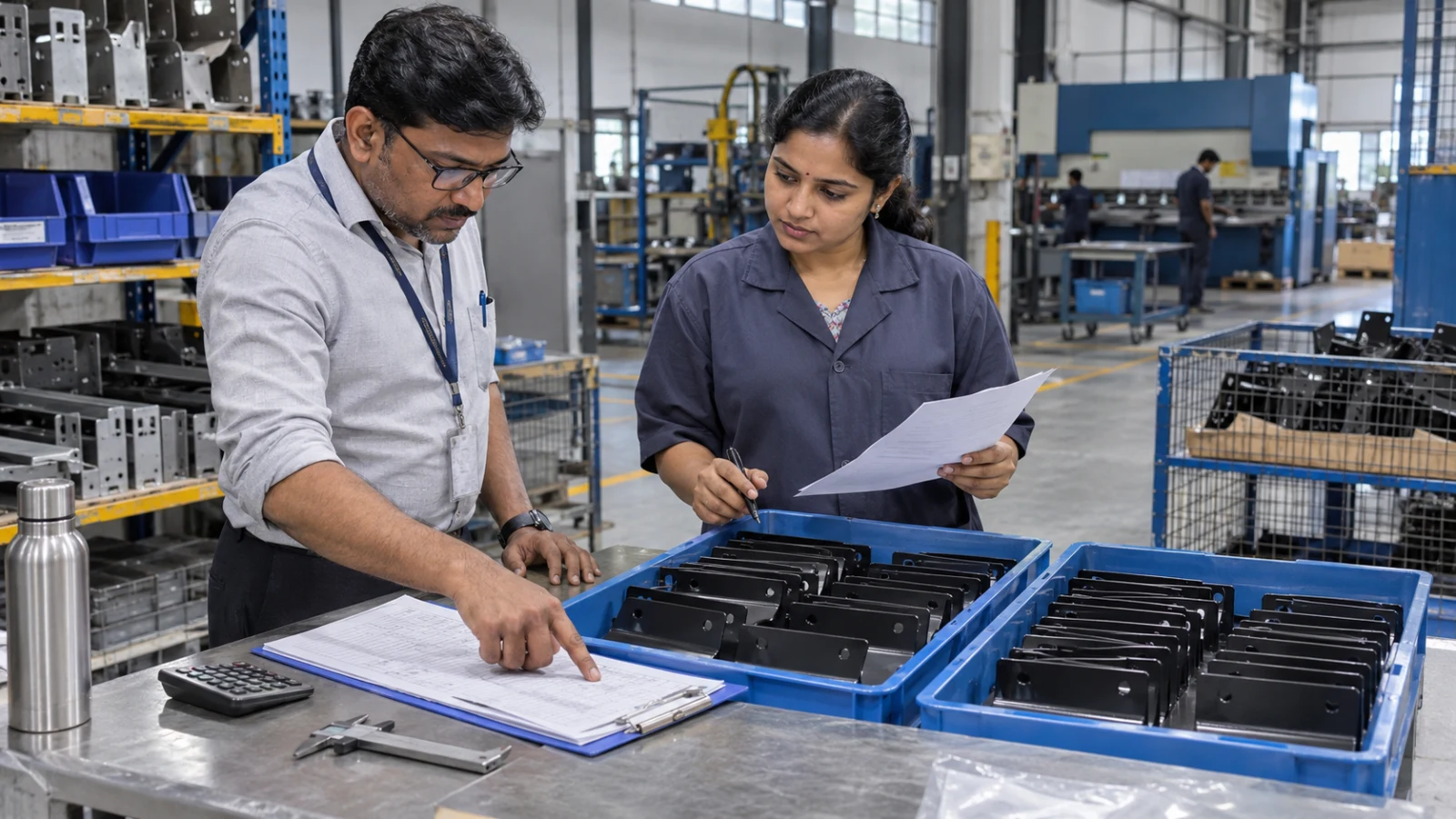
Cover disclosure: The cover photograph is an AI-generated editorial illustration of a fictional factory review. It does not show a GreyBath client, a real job worker or real production records.
The factory prepares the outward challan.
The transporter collects the material.
The vendor acknowledges receipt.
A few days later, the vendor informs the production manager:
Your material is ready. We are sending it back.
The factory receives the processed components.
Stores counts the material.
Quality begins inspection.
But something does not match.
The company sent 1,000 brackets.
Only 990 can initially be accounted for in the return records.
The production manager asks the vendor about the remaining ten.
The vendor says the complete quantity has been processed.
Stores says it received only the quantities recorded in its inward register.
Accounts has already received the job-work service invoice.
Management now needs to establish what actually happened.
Are ten brackets missing, still being processed, rejected, scrapped or simply recorded under another return document?
These are very different situations.
For small engineering manufacturers, fabrication businesses, plastics manufacturers and other companies that outsource production processes, this is an important operational problem.
The solution does not necessarily require a new ERP.
It starts with connecting the original material movement to every subsequent processing and return record.
Sending material outside does not mean the material has been consumed
Consider a manufacturing company that performs most production activities internally but outsources powder coating.
The factory produces metal brackets.
The brackets are sent to another company for surface treatment.
After processing, they return for inspection and final assembly.
The material has physically left the manufacturer's premises.
But that does not automatically mean the material has been sold, consumed or transferred permanently to the processor.
In an ordinary principal-supplied job-work arrangement, the external processor performs an agreed activity on material belonging to the principal.
The exact legal and accounting treatment depends on the arrangement.
For qualifying Indian GST job work, Section 143 establishes a framework for sending inputs and specified capital goods to job workers, subject to prescribed conditions. India Code: CGST Act
Three questions must remain separate
Where is the material?
It may be at the manufacturer's factory, with a job worker, in transit or at another authorised location.
What processing has happened?
It may be unprocessed, partly processed, completed, rejected or awaiting inspection.
What is its commercial or accounting position?
It may remain company-owned material, form part of work in progress, be subject to an authorised scrap decision or require another appropriate accounting treatment.
A business should not assume these three positions are identical.
For example, a completed component may still be physically held by the job worker.
A returned component may still be awaiting quality approval.
And an unused component may be physically available at the vendor's premises but not available for immediate production at the manufacturer's factory.
A dependable job-work process must preserve all three distinctions.
The job-work order and the material movement are not the same record
Many companies raise one job-work order and assume it describes the complete transaction.
But a job-work order primarily establishes what processing is required.
It may specify the item, process, quantity, agreed rate and expected completion date.
The physical material movement needs its own supporting record.
Consider a manufacturer issuing a job-work order for powder coating 1,000 brackets.
The order explains what the supplier is expected to do.
The outward material record establishes what the manufacturer recorded as being sent.
The job worker's acknowledgement establishes what the processor recorded as received.
The return record establishes what came back.
The quality record establishes what the manufacturer accepted.
Different records answer different questions
| Business record | What it helps establish |
|---|---|
| Job-work order | Processing requirement and agreed commercial instructions |
| Outward challan/material-out record | Material recorded as dispatched |
| Job-worker receipt acknowledgement | Quantity the processor confirms receiving |
| Processing record | Work completed, unfinished and relevant process outcomes |
| Return challan/material-in record | Material recorded as returned |
| Goods-receipt record | Quantity physically received by the manufacturer |
| Quality-inspection record | Quantity accepted, rejected or held for review |
| Scrap or loss record | Documented process loss, scrap or other disposition |
| Reconciliation record | How the original quantity has been accounted for |
These records may exist inside one ERP.
They do not need to be maintained in separate applications.
The important requirement is that each record preserves its actual meaning.
The first difference may occur before processing begins
Suppose Stores prepares 1,000 brackets for dispatch.
The outward challan also states 1,000.
The vendor receives the material and records 995.
The manufacturer's outward record and the vendor's inward record now disagree.
That difference should be investigated before processing begins.
Otherwise, the manufacturer may later expect 1,000 processed brackets while the job worker maintains that it received only 995.
Confirm actual receipt
A useful acknowledgement should identify:
The original outward challan.
The material and specification.
The quantity physically received.
The receipt date.
Any shortage, damage or other discrepancy.
The responsible receiving person or authorised record.
A signed document or electronic acknowledgement may support this process.
However, the business should understand exactly what is being acknowledged.
A transport receipt does not necessarily establish that every internal component was counted.
Similarly, a job worker's confirmation that material arrived does not automatically establish that the recorded quantity is correct.
For important consignments, the parties should agree on how quantity differences will be recorded.
A worked example: 1,000 brackets sent, 990 accounted for
Consider a fictional company called Western Precision Fabricators Pvt Ltd.
It manufactures metal components for industrial equipment suppliers.
The company performs cutting, bending and drilling internally.
Powder coating is outsourced to a job worker in Maharashtra.
This is a hypothetical example, not a GreyBath client project.
The company sends 1,000 unfinished metal brackets for coating.
Each bracket remains one identifiable physical piece throughout the process.
This assumption matters because the reconciliation below uses the same unit of measurement for every quantity.
Material dispatched
Outward challan: JW-041
Material: Metal bracket, approved specification
Quantity: 1,000 pieces
Process: Powder coating
Job worker: Approved outside processor
Quantity acknowledged by job worker: 1,000 pieces
The vendor begins processing.
Several days later, material starts returning.
First reconciliation
The manufacturer's records show:
| Material outcome | Quantity |
|---|---|
| Powder-coated brackets returned and quality-accepted | 940 |
| Powder-coated brackets returned but rejected during inspection | 25 |
| Unprocessed brackets returned | 15 |
| Unusable brackets returned for scrap review | 10 |
| Total physically returned and accounted for | 990 |
| Initial unexplained difference | 10 |
| Original quantity sent | 1,000 |
All quantities are hypothetical.
The calculation is:
940 + 25 + 15 + 10 = 990
Therefore:
1,000 − 990 = 10 brackets requiring investigation
The company should not automatically classify the ten brackets as stolen, lost or scrapped.
At this stage, the records establish only that ten brackets have not been accounted for in the documented returns.
What the investigation discovers
The production coordinator contacts the job worker.
The vendor reviews its remaining work area and confirms that ten unprocessed brackets are still physically held at its premises.
The manufacturer obtains appropriate confirmation of their identification, quantity and location.
The records are updated.
The final position becomes:
| Material outcome | Quantity |
|---|---|
| Returned and quality-accepted | 940 |
| Returned and rejected | 25 |
| Returned unprocessed | 15 |
| Returned as unusable material awaiting scrap disposition | 10 |
| Verified unfinished material still with the job worker | 10 |
| Total reconciled quantity | 1,000 |
The arithmetic now balances.
940 + 25 + 15 + 10 + 10 = 1,000
There is no longer an unidentified physical quantity within the assumptions of this example.
But does that mean the job-work order is complete?
No.
Ten brackets are still with the job worker.
Twenty-five returned brackets require the appropriate quality decision.
Another ten unusable brackets await authorised scrap disposition.
The business has successfully reconciled the quantity.
It has not necessarily completed every operational and commercial obligation.
This is the difference between material reconciliation and job-work closure.
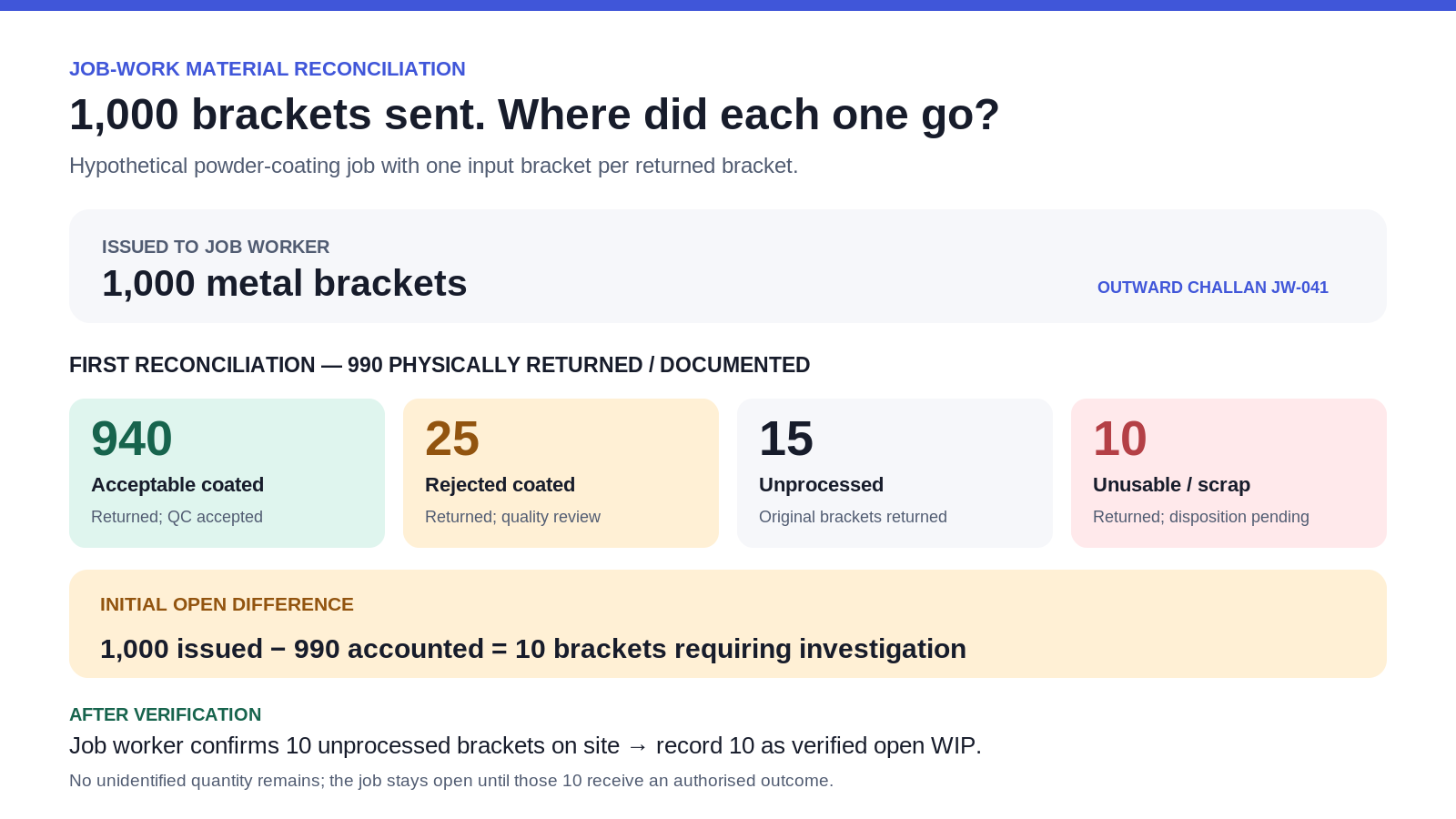
Owner-supplied 2D educational diagram based only on the hypothetical quantities in this article.
Material returned is not always material accepted
This distinction is especially important when a job worker performs a process that affects product quality.
Consider the 25 powder-coated brackets rejected during inspection.
The components have physically returned.
Stores can count them.
The inward movement can be recorded.
But Quality has not accepted them for normal production use.
The business needs to decide whether they can be reworked, require further inspection or must follow another authorised disposition.
That decision should be documented.
Do not change rejected material into accepted stock automatically
A receiving employee may record 965 coated brackets arriving from the job worker.
But if only 940 pass inspection, the company should not automatically present all 965 as usable finished components.
The receiving and quality records should preserve the difference.
For example:
Physically received after coating: 965
Quality accepted: 940
Rejected or held for review: 25
The returned unprocessed and unusable quantities remain separate.
This helps Production understand what is genuinely available for the next operation.
It also prevents a later dispute about whether a job worker delivered the required acceptable quantity.
Scrap and process loss need an agreed method
Some outside processes naturally create scrap or process loss.
For example:
Cutting material may produce offcuts.
Machining may produce metal chips.
Trimming operations may produce waste.
Surface treatment may result in rejected or damaged pieces.
These outcomes should not be treated as identical.
Scrap is not automatically an unexplained shortage
Suppose a processor receives 100 kilograms of material.
After processing, the company records a combination of usable output, recoverable scrap, documented process loss and remaining material.
The correct reconciliation depends on the process.
For illustration:
| Material outcome | Weight |
|---|---|
| Accepted processed output | 88 kg |
| Recoverable scrap | 7 kg |
| Documented process loss | 3 kg |
| Material still in process | 2 kg |
| Total | 100 kg |
Hypothetical example. The quantities and process-loss assumptions are not industry standards.
This example is deliberately measured in kilograms.
It would be incorrect to compare 100 kilograms of raw material directly against 500 finished pieces without an approved conversion or yield calculation.
Use a suitable measurement basis
For some processes, piece count works.
For others, weight, length, area or another measurement may be more appropriate.
Where one input produces several outputs, use the approved bill of materials, process specification and yield rules.
The business should document the relationship between input and output quantities.
Who owns the scrap?
The answer depends on the commercial agreement, applicable law and the actual transaction.
The job worker should not automatically be assumed to own all scrap generated during processing.
Likewise, the principal should not automatically treat all reported process loss as an acceptable deduction.
The applicable contract and authorised technical and accounting decisions matter.
For Indian GST transactions, Section 143 also contains provisions addressing waste and scrap generated during job work. The tax treatment should be reviewed with an appropriately qualified professional. India Code: CGST Act
A material-tracking system should preserve the relevant evidence without independently deciding the commercial or tax treatment.
One job-work order may involve several dispatches and returns
Consider a manufacturer that sends 5,000 components for outside finishing.
The job worker cannot process everything immediately.
The manufacturer sends materials in three dispatches.
The vendor returns completed material across four separate consignments.
If Accounts or Stores maintains only one total against the vendor, the records may become difficult to reconcile.
Keep the movement history
A practical record should identify:
Original job-work order
Each outward material challan
Each acknowledged receipt
Each return challan
Each inward receipt
Relevant processing batch
Quality outcome
Remaining open quantity
This enables the company to investigate a particular movement rather than repeatedly asking the vendor for an overall balance.
Do not force one return to close one dispatch
A job worker may combine materials from different dispatches during processing, where the arrangement permits it.
Alternatively, one outward consignment may produce several returns.
The system should support the actual relationship.
But the required traceability must not be lost.
If customer specifications or quality requirements prevent material from being mixed, the company needs appropriate batch or lot-level controls.
A material balance should identify where the quantity is held
A common report displays:
Material sent: 10,000 units
Material received: 8,500 units
Balance: 1,500 units
This looks useful.
But what does the balance represent?
It could include:
Material not yet processed.
Completed material awaiting dispatch.
Material held for quality review.
Scrap awaiting an authorised decision.
Material transferred to another approved processor.
A genuine unexplained shortage.
These should not automatically appear as one undifferentiated quantity.
Use meaningful operational categories
A more useful report could distinguish:
| Category | Meaning |
|---|---|
| Awaiting processing | Material confirmed at the job worker but not yet processed |
| Processing in progress | Material undergoing the agreed operation |
| Completed, awaiting return | Processing finished but material not yet received back |
| Returned, awaiting quality decision | Material physically received but not yet accepted |
| Accepted return | Returned material approved for the intended next use |
| Rejected return | Returned material subject to a quality decision |
| Scrap or process loss | Quantity supported by the relevant approved evidence |
| Unexplained difference | Quantity that cannot yet be reconciled with verified records |
These are illustrative reporting categories.
A manufacturer does not need every category if the process does not require it.
The objective is to make unresolved quantities understandable.
Do not rely only on the job worker's monthly statement
A vendor may send a monthly statement showing material received, processed and returned.
That statement can be useful.
However, the manufacturer should not assume it automatically agrees with its own records.
Consider these differences:
The vendor records a receipt date different from the manufacturer's dispatch date.
The manufacturer records 1,000 pieces sent.
The vendor records 995 pieces received.
The vendor includes rejected material in completed production.
The manufacturer records only quality-accepted material.
A return is recorded under a different challan reference.
These differences may explain why two records show different balances.
Reconcile both sides
The manufacturer's outward register should be compared with the processor's receipt acknowledgements.
The processor's return information should be compared with the manufacturer's inward records.
Important differences should have a named owner.
Do not overwrite one party's original record merely to make totals agree.
Preserve the original information and document the correction or reconciliation.
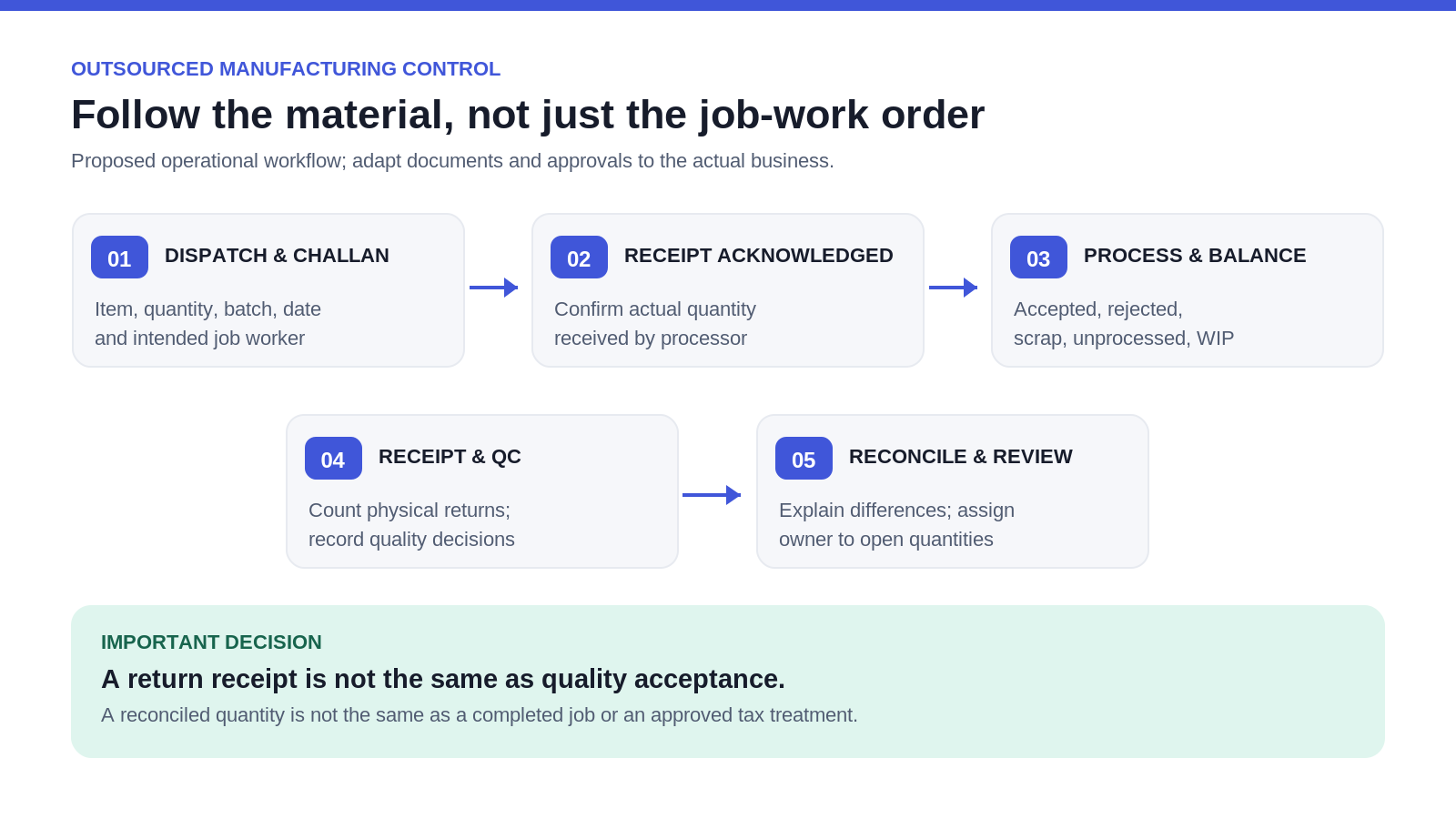
Owner-supplied 2D educational workflow; it is not a screenshot of a client system.
Your existing accounting software may already support job-work tracking
Before developing a new application, examine the software already in use.
Some SME accounting and ERP systems support job-work transactions.
TallyPrime
TallyPrime documents job-work orders, material-out and material-in vouchers, movement registers and reports for stock held with job workers.
Its official help documentation, updated on 22 October 2026, describes reporting on materials sent to processors and finished goods received. TallyHelp
The documented reports include ways to review outstanding job-work orders and material quantities.
Before commissioning another tracking system, check whether the required features are available and correctly configured in the company's installation.
Odoo 19
Odoo's subcontracting documentation describes workflows involving components supplied to external processors, dedicated subcontracting locations and receipt of finished products.
Its resupply model distinguishes component transfers from receipt of the subcontracted product. Odoo
This provides a useful example of why subcontractor stock should not be treated as ordinary material sitting in the manufacturer's own warehouse.
What about a simpler business?
A manufacturer with only two job workers and a few transactions per month may not need an elaborate system.
A controlled register linked to its existing accounting records may be sufficient.
The software decision should depend on transaction volume, required traceability and the difficulty of maintaining reliable records.
Build a job-work register that can answer the important questions
A basic spreadsheet can support the process when its fields are clearly defined.
Suggested working register
| Field | Example |
|---|---|
| Job-work order | JWO-026 |
| Job worker | Approved powder-coating vendor |
| Outward challan | JW-041 |
| Dispatch date | 26 October 2026 |
| Item reference | BR-014 |
| Material sent | 1,000 pieces |
| Vendor-acknowledged quantity | 1,000 pieces |
| Accepted returned quantity | 940 pieces |
| Rejected returned quantity | 25 pieces |
| Unprocessed returned quantity | 15 pieces |
| Unusable material returned | 10 pieces |
| Verified material still with job worker | 10 pieces |
| Unexplained quantity | 0 pieces |
| Responsible owner | Production coordinator |
| Job-work closure status | Open |
| Next action | Resolve pending processing and quality decisions |
All references and quantities are illustrative.
The register should refer to the recognised transaction documents.
It should not become a second independent inventory ledger that employees update without reconciling the official records.
Preserve the original quantity
Suppose a dispatch was originally recorded as 1,000 pieces.
An investigation later confirms that only 995 were physically loaded.
The company should document the correction using the appropriate accounting and inventory procedure.
It should not silently overwrite the original dispatch record and remove the evidence of the discrepancy.
Controlled corrections improve traceability.
Unrecorded changes make future reconciliation more difficult.
Assign responsibility for the balance
When materials remain with a job worker, somebody in the manufacturer's organisation needs to own the follow-up.
The external processor is responsible for the work and obligations under its agreement.
But internal coordination still needs a clear owner.
A practical responsibility model could be:
| Activity | Suggested responsibility |
|---|---|
| Prepare outward material record | Stores |
| Confirm material specification and processing requirement | Production or technical team |
| Obtain job-worker receipt acknowledgement | Job-work coordinator |
| Review unfinished material | Production planning |
| Receive returned material | Stores |
| Inspect returned processed goods | Quality |
| Review scrap or process-loss records | Authorised production/quality personnel |
| Approve commercial adjustments | Authorised commercial or accounts manager |
| Review GST documentation | Accounts or tax professional |
| Close operational exceptions | Designated job-work owner |
A small company may combine several of these responsibilities.
What matters is that an unexplained quantity should not remain open simply because every department assumes another person is following up.
When material moves from one job worker to another
Some manufacturing processes involve more than one external processor.
For example:
A metal component goes for heat treatment.
It then goes for surface finishing.
Finally, it returns to the manufacturer for inspection.
The material may move directly from the first processor to the second.
In that situation, the manufacturer needs visibility into both movements.
It should know what left the first processor, what the second processor acknowledged and which records support the transfer.
The appropriate documentation and GST procedure depend on the transaction.
Section 143 provides for movements through subsequent job workers subject to its conditions. India Code: CGST Act
Do not treat an inter-vendor transfer as a final return
A movement from Job Worker A to Job Worker B is not necessarily material returned to the principal manufacturer.
Similarly, material physically held by the second processor should not disappear from the manufacturer's outstanding material records.
The business should preserve the movement chain.
This becomes more important where several processing operations occur before the final goods return.
Job-work records also support GST compliance
For Indian manufacturers, job-work tracking is not only an internal production issue.
The relevant GST framework places responsibilities on the principal.
Section 143 of the CGST Act provides that, under prescribed conditions, registered principals may send inputs and certain capital goods for job work without payment of tax.
The section also addresses time limits and consequences where goods are not returned or otherwise dealt with under the prescribed procedure.
Under the statutory framework, the general periods include one year for inputs and three years for specified capital goods, subject to the applicable provisions, exclusions and potential extensions. India Code: CGST Act
These are not blanket deadlines for every physical item or every commercial outsourcing arrangement.
Operational records support the tax review
The accounts team may need details of:
Material dispatched
Relevant challan references
Job worker identity
Dispatch and receipt dates
Material returned or transferred
Relevant scrap and waste information
Outstanding material and its status
These records may support the applicable challan and Form GST ITC-04 processes, where required.
The precise filing requirements, reporting period and tax treatment should be verified against current GST provisions and the manufacturer's circumstances.
Do not use a general inventory dashboard as proof of GST compliance.
The manufacturer remains responsible
Section 143(2) specifically places responsibility for maintaining proper accounts of the relevant inputs or capital goods on the principal. India Code: CGST Act
This is one reason why merely relying on the job worker's informal monthly statement may be insufficient.
A dependable internal record helps the manufacturer maintain visibility.
However, the final compliance process should remain under appropriately authorised accounting and tax personnel.
A reconciled quantity is not necessarily an approved commercial outcome
Return to the example of 1,000 brackets.
The manufacturer now knows where all 1,000 are accounted for.
But several decisions remain.
Twenty-five returned components were rejected.
Ten unusable pieces await scrap disposition.
Ten pieces remain with the processor.
The job worker may also have issued a processing invoice.
Should the manufacturer approve the full job-work charge?
That depends on the agreement.
The contract may specify payment based on processed quantity, accepted quantity, weight, agreed wastage or another basis.
The business should not assume that all returns create identical payment obligations.
Connect the commercial decision to the actual work
Before approving a disputed service invoice, Accounts may need confirmation from Production or Quality.
For example:
Quantity processed
Quantity accepted
Quantity requiring rework
Approved scrap or process loss
Outstanding work
Applicable contractual charging basis
A software workflow can present these facts to an authorised employee.
It should not automatically decide a disputed invoice without the appropriate rules and approval.
This also prevents an avoidable situation where the service invoice is marked complete while the underlying job-work order still has unresolved quantities.
Monitor unresolved material, not just completed jobs
A management report showing:
50 job-work orders completed
may look useful.
But it may hide unfinished balances and unresolved processing differences.
A more informative report should track several separate outcomes.
Material with job workers
Identify the verified quantity currently held by each job worker.
Distinguish it from quantities in transit or awaiting acknowledgement.
Where appropriate, show item, batch, order and age.
Unexplained quantity differences
Track quantities that cannot yet be reconciled against verified movements and authorised process outcomes.
Do not classify all unreturned material as unexplained.
Material confirmed as unfinished work is an open balance, not automatically a shortage.
Age of open job-work balances
Track how long material has remained with the processor.
A long-running job may be legitimate, but it should have an explanation and an agreed next action.
Returns awaiting quality decisions
Identify processed goods that have physically returned but cannot yet be used.
This prevents Production from assuming all inward quantities are accepted stock.
Scrap and process-loss exceptions
Review quantities outside the approved technical or contractual expectations.
A variance is a signal for investigation, not automatic proof of misconduct.
Job-work closure completeness
A practical internal control is to verify that closure requirements have been satisfied.
Those requirements may include material reconciliation, approved quality disposition, necessary documentation and applicable commercial review.
The precise requirements should follow the business.
Do not close the job merely because the arithmetic balances.
When a spreadsheet becomes difficult
A spreadsheet may work for a small manufacturer with limited job-work activity.
However, manual coordination can become unreliable when:
Several job workers handle different stages of the same product.
One job-work order produces several outward and inward movements.
Different employees maintain separate registers.
Material is transferred directly between processors.
Returned quantities require quality segregation.
Scrap and rework approvals remain outside the main records.
Management cannot identify unresolved balances across locations.
At this point, a more connected workflow may be worthwhile.
But the first requirement is to establish a reliable operating process.
A new application cannot automatically correct inconsistent item codes, missing vendor acknowledgements or undocumented processing losses.
When a connected system becomes useful
A manufacturer may already maintain different information in separate systems.
ERP: Material masters, orders and inventory transactions.
Stores: Outward and inward quantities.
Production: Job-work requirements and completion status.
Quality: Accepted, rejected and rework quantities.
Accounts: Processing invoices and vendor balances.
Management: Outstanding material and exception reports.
A connected system could bring the relevant references into one workflow.
Before development, the company must decide which system is authoritative for each record.
Avoid creating a second inventory ledger
If the ERP already records official stock movements, a new job-work dashboard should not independently maintain another inconsistent stock balance.
It should use supported data interfaces or authorised imports wherever appropriate.
The design must also account for:
Consistent item and batch references
Correct units of measurement
One-to-many relationships between dispatches and returns
Role-based access
Approval history
Corrections without deleting original evidence
Integration failures and delayed updates
The purpose is dependable operational visibility, not another place for employees to enter the same information.
Do not begin with AI-based material reconciliation
A manufacturer may ask:
Can AI automatically read all challans and tell us how much material is pending?
Document extraction may help with certain repetitive tasks.
But it cannot replace missing operational evidence.
Suppose the outward challan says 1,000 pieces.
The return document says 990.
AI can identify the numerical difference.
It cannot independently establish whether the remaining ten pieces are with the processor, were scrapped, were returned under another reference or were never received.
Those facts require reliable source records and appropriate verification.
Start with structured information
Where possible, record outward and inward transactions directly in the existing system.
Use stable references.
Maintain the required supporting evidence.
Identify discrepancies.
Assign investigation responsibility.
Only then assess whether document extraction or other automation would reduce meaningful manual work.
AI may help organise information.
It should not invent missing material movements or approve unsupported inventory adjustments.
Where this method needs to change
The worked example concerns one metal bracket remaining one physical bracket throughout powder coating.
Other processes are more complicated.
A textile processor may receive material in metres or kilograms and return material measured differently.
A plastics manufacturer may provide raw material that is converted into many moulded components.
A metal processor may produce finished parts, offcuts and recoverable scrap.
A chemical processor may have documented process yields and losses.
A business manufacturing regulated goods may require additional batch traceability, quality release or documentation controls.
In these cases, a simple piece-count equation may be insufficient.
Use appropriate bills of materials, yield specifications, unit conversions and approved technical records.
The purpose is not to force every process into the same calculation.
It is to establish a reliable relationship between the material sent and the outcomes that must be accounted for.
The management decision
When material is sent for outside processing, management should not assume that the job-work order contains the complete material history.
The business needs to know:
What material was physically dispatched?
What did the job worker actually receive?
How much has been processed?
How much has returned?
What quantity has passed quality inspection?
What material remains with the processor?
What scrap or process loss has been documented?
Which differences remain unexplained?
Who is responsible for resolving them?
Start with the existing accounting or ERP software.
Use a controlled job-work register.
Preserve movement references.
Reconcile physical quantities separately from quality and commercial decisions.
Then assess whether the business needs additional software.
A manufacturer should not need to search old challans, emails and WhatsApp messages every time management asks how much material is lying with a job worker.
The objective is not just to know how much material was sent outside. It is to know what happened to that material and what still requires action.
Where GreyBath can contribute
GreyBath develops custom business applications, ERP workflows, dashboards, portals and system integrations.
For manufacturers using multiple outside processors, a potential GreyBath implementation could connect job-work orders, outward challans, job-worker acknowledgements, inward receipts and pending material balances in one controlled workflow.
Depending on existing systems, this could include subcontractor-wise material tracking, partial-return records, discrepancy alerts, quality-review assignments, approval workflows and management dashboards.
A proposed portal could allow authorised internal users or approved job workers to update relevant processing information, subject to defined permissions and verification controls.
Where supported APIs or authorised exports exist, GreyBath could assess integration with the manufacturer's existing ERP rather than replacing it.
Any implementation would depend on item-master accuracy, movement records, supported interfaces, access permissions and the agreed scope.
GreyBath would not independently verify physical stock, approve scrap, determine product conformity or replace the manufacturer's tax and accounting responsibilities.
For smaller companies, properly configured TallyPrime, another existing ERP or a controlled spreadsheet may already be sufficient.
GreyBath's implementation opportunity is to connect material movements, processing status and unresolved exceptions when maintaining that visibility manually becomes unreliable.
Relevant services include GreyBath ERP, CRM, Portals & Dashboards and GreyBath Custom Web Applications & Integrations.
Sources reviewed
The operational recommendations and product examples above were checked against these primary or official sources. Product features, legal duties and filing requirements can change; verify current applicability before implementation.
Keep reading
More practical thinking from GreyBath across design, engineering and growth.
All articles