

Two Departments Ordered the Same Material. The Second Purchase Wasn't Needed.
A practical method for consolidating department requests, usable stock and confirmed incoming supply before placing another supplier order.

Share this article
Browse all insightsIt is Monday morning at a manufacturing company.
Cover disclosure: the cover is an AI-generated editorial illustration. The people, organisation, records and situation are fictional and do not depict a GreyBath client.
The maintenance department needs 60 industrial bearings for planned repair and replacement work.
The maintenance supervisor sends a purchase request.
Later that morning, Production requests another 40 bearings of the same specification for upcoming manufacturing work.
The purchasing employee checks the first request and contacts a supplier.
Another employee processes the second request.
Both orders are approved.
Both suppliers receive purchase orders.
A few days later, the materials arrive.
The stores department now has more bearings than the factory needs.
Management asks:
Why did we purchase so much material when we already had stock and another order was on the way?
The employees have different explanations.
Maintenance says it requested only what it needed.
Production says its requirement was genuine.
Purchasing says both requests were approved.
Stores says it never received a consolidated requirement before the orders were placed.
Nobody necessarily made a false request.
The problem was that the company approved individual purchases without checking the complete material requirement.
For small manufacturers, industrial distributors and trading companies, this can create unnecessary stock, additional supplier commitments and avoidable pressure on working capital.
The solution does not always require a new ERP.
It starts with distinguishing what a department needs from what the company still needs to purchase.
Two genuine requirements can still produce an unnecessary purchase
Consider a company with three departments.
Production uses bearings for assembly.
Maintenance uses the same bearings for machine repairs.
Projects occasionally uses them for installation work.
Each department understands its own requirement.
However, the purchasing team must consider the combined position.
A request for 60 bearings does not automatically mean the business must order 60.
The company may already have usable stock.
Another department may have ordered the same material.
A confirmed supplier purchase order may already be pending delivery.
Alternatively, the required material may be available at another location and capable of reaching the requesting department on time.
This creates an important distinction.
A purchase request expresses an internal requirement. A purchase order creates a purchasing commitment with a supplier.
Zoho ERP's official documentation uses this distinction: purchase requests are internal documents raised before procurement, while purchase orders are issued to vendors after the relevant purchasing decisions.
An SME should apply this principle even when requests arrive through email, WhatsApp or handwritten notes.
The company can accept several genuine requests without placing several separate supplier orders.
Purchase requests should not automatically become purchase orders
Imagine a maintenance supervisor sending:
We need 60 bearings urgently.
The purchasing employee creates a supplier order for 60 bearings.
The process appears efficient.
But it skips an important decision:
Does the company already have enough usable material, including incoming stock, to meet this requirement?
A more dependable purchasing process has two stages.
Stage 1: Record the requirement
The department explains what is required, the quantity, specification, destination and required date.
This becomes an internal purchase request.
Stage 2: Determine the actual purchasing requirement
Procurement reviews existing stock, other requests, reservations, pending supplier orders, delivery dates and purchasing conditions.
Only then does it determine whether another supplier commitment is necessary.
These stages should not be confused.
An approved internal request means the requirement is legitimate and authorised under the company's rules.
It does not automatically mean the full requested quantity must be purchased externally.
A worked example: 100 bearings requested, but only 30 need to be purchased
Consider a fictional company called Sahyadri Engineering Components Pvt Ltd.
The company manufactures industrial equipment components in Maharashtra.
It operates one factory with separate Production, Maintenance and Stores departments.
This is a hypothetical example, not a GreyBath client case.
On 22 October 2026, two departments raise material requests.
| Department | Material | Quantity required | Required by |
|---|---|---|---|
| Maintenance | Bearing BR-6205 | 60 | 4 November 2026 |
| Production | Bearing BR-6205 | 40 | 4 November 2026 |
| Combined requirement | Bearing BR-6205 | 100 |
Both departments need the same approved item specification at the same factory.
Stores reviews the current position.
Usable, unreserved stock: 25 bearings.
Existing confirmed supplier order: 50 bearings.
Expected receipt of that order: 30 October 2026.
For this example, assume the incoming 50 bearings are correctly specified, not allocated to another requirement and expected to be available before 4 November.
The company now calculates the additional quantity needed.
The calculation
Total approved requirement: 100 bearings
Available, unreserved stock: 25 bearings
Confirmed incoming stock available before the required date: 50 bearings
Therefore:
100 − 25 − 50 = 25 bearings
The company needs to purchase another 25 bearings, not 100.
Suppose the supplier sells this bearing in packs of 10.
The purchase quantity must be rounded to the next permissible pack size.
The company therefore orders:
30 bearings
This produces a different purchasing decision.
| Purchasing approach | New quantity ordered |
|---|---|
| Maintenance request processed independently | 60 |
| Production request processed independently | 40 |
| Total if processed independently | 100 |
| Consolidated requirement after checking existing supply | 25 |
| Quantity purchased after pack-size adjustment | 30 |
The independent approach creates purchase orders for 100 bearings.
The coordinated approach creates a purchase order for 30.
The difference is 70 bearings that the business did not need to order for these requirements.
What does this mean financially?
Assume the purchase price is ₹400 per bearing.
This is an illustrative price used only for the calculation.
Under the independent purchasing approach:
100 × ₹400 = ₹40,000
Under the coordinated approach:
30 × ₹400 = ₹12,000
The difference in new purchase commitments is:
₹40,000 − ₹12,000 = ₹28,000
This does not establish that the company would have permanently lost ₹28,000.
The additional bearings might be used later.
However, the business would have committed an additional ₹28,000 to inventory that was not required for the two current departmental needs.
That can affect cash availability, storage and future purchasing flexibility.
What happens to closing stock?
Assume every confirmed delivery arrives, all 100 required bearings are consumed and no other stock movements occur.
Under the independent approach:
25 existing + 50 incoming + 100 newly purchased − 100 consumed = 75 bearings remaining
Under the coordinated approach:
25 existing + 50 incoming + 30 newly purchased − 100 consumed = 5 bearings remaining
Both calculations are internally consistent.
The difference in closing inventory is 70 bearings.
Whether the additional stock would be useful later depends on future demand, storage conditions and other business requirements.
For this example, the problem is not that the company bought material with no possible future use.
It is that the company made an unnecessary additional purchasing commitment without reviewing available supply.
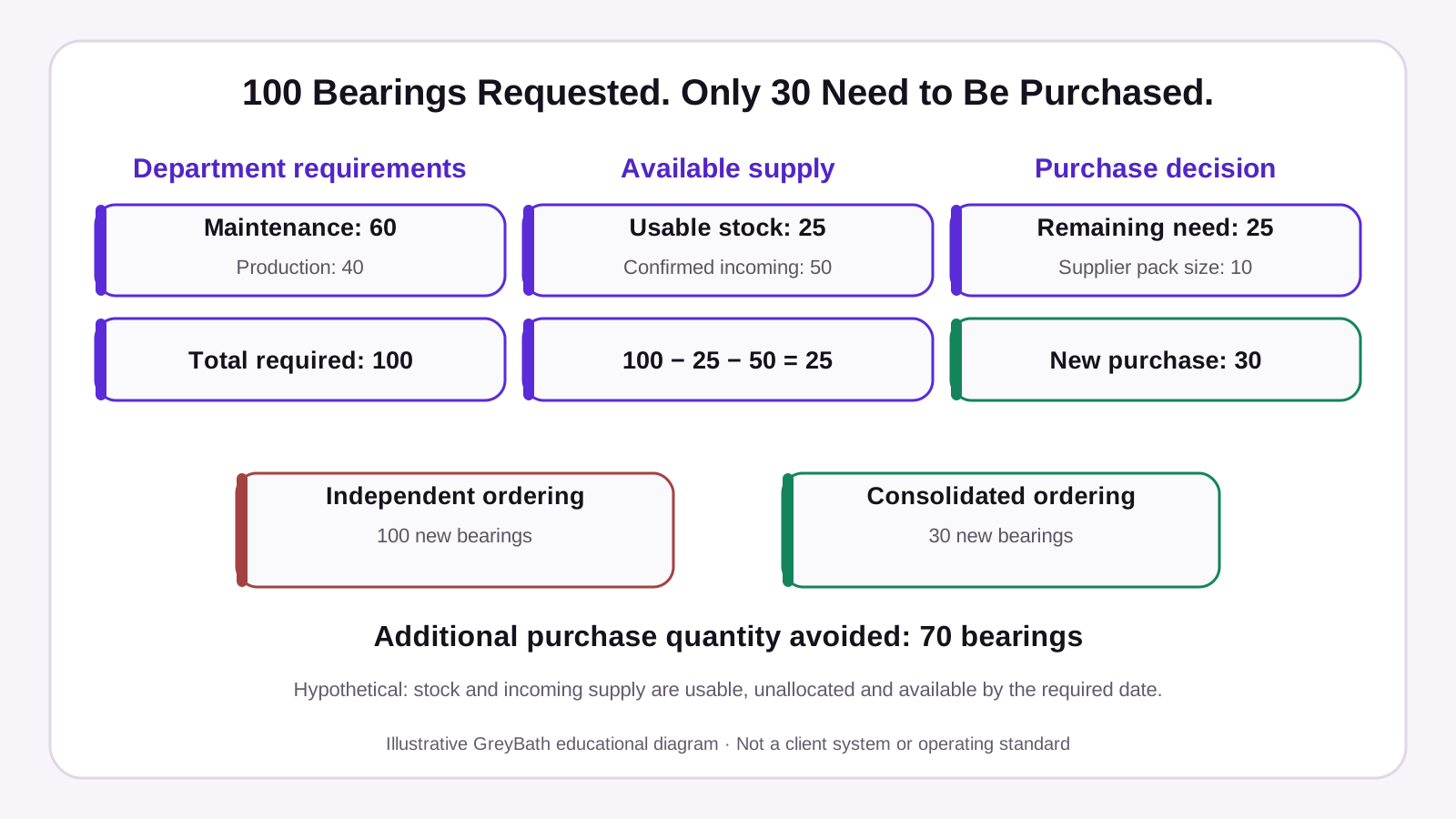
Original GreyBath 2D educational diagram recreated from the owner-supplied visual specification. Figures and examples are illustrative.
Do not combine requests just because the product description looks similar
The worked example assumes the bearings are genuinely interchangeable.
In real factories, item descriptions are often inconsistent.
Maintenance may request:
Bearing 6205
Production may request:
Deep-groove bearing 6205-2RS
Stores may maintain the item under an internal component code.
Those descriptions may refer to different specifications.
A purchasing employee should not combine them based only on a similar name.
Match the actual item
The required comparison may include the manufacturer's part number, dimensions, grade, material, tolerance, seals, rating, approved brand or customer-specific requirement.
The level of detail depends on the product.
For packaging materials, thickness, dimensions, printing specification or approved substrate may matter.
For chemicals, grade and specification can be critical.
For electronic components, revision and manufacturer approval may matter.
The item code must have a clear meaning
A business can maintain one internal SKU for each defined, approved item specification.
Where suitable alternatives exist, the item master should record the approved substitution rules.
Do not allow an automated purchasing rule to treat two materials as interchangeable unless the authorised technical or quality team has established that they are.
A duplicate warning is useful.
An incorrect automatic substitution can create a more serious problem.
Quantity alone does not tell procurement whether another order is required
Suppose the business has 500 units of a material in stock.
That does not necessarily mean it has 500 available for the new request.
Some units may be reserved for confirmed work.
Some may be awaiting inspection.
Some may be unsuitable for the requesting department.
The same principle applies to incoming purchases.
A pending supplier order may already be committed to another production requirement.
Or its delivery may be too late.
A useful purchasing calculation therefore considers:
Approved requirements
Usable, unreserved stock
Confirmed incoming quantities
Expected availability dates
Existing allocations
Required destination
Supplier purchasing constraints
A practical requirement formula
For a defined item, location and required date:
Additional purchasing need = Approved outstanding demand − Usable unreserved stock − Confirmed unallocated incoming supply available by the required date
If the result is negative, the additional purchasing need for that requirement is zero.
Then apply relevant purchasing conditions, such as minimum order quantities or pack-size multiples.
This is a simplified operational framework.
An ERP may already calculate forecast availability using its own stock and demand rules. If so, do not subtract the same reservations or demand again.
The formula also assumes that the incoming supply is credible and usable by the required date.
If the delivery is uncertain, procurement should review the risk rather than automatically treating the goods as available.
A pending purchase order is not the same as material received
Imagine that Procurement placed an order for 200 cartons of packaging material.
The supplier has acknowledged the order.
The goods are expected in five days.
Stores has not received them.
Production needs 100 cartons tomorrow.
Can the pending order satisfy that requirement?
Not if the material cannot arrive in time.
The purchasing system needs to distinguish at least three events.
Purchase order issued
The company has sent a formal purchasing instruction.
Depending on the circumstances and terms, this may create a binding commercial commitment.
Supplier acknowledgement
The supplier has confirmed the relevant order details or delivery position.
A purchase order appearing in the company's ERP does not automatically prove that the supplier has accepted every requested condition.
Goods received and accepted
The business has physically received the material and completed the required receiving or quality processes.
These stages are different.
Zoho ERP documents converting purchase orders into purchase-receipt records, while Odoo's purchasing documentation distinguishes ordered and received quantities when controlling vendor bills.
For an SME, this means an open purchase order should be visible to the buyer, but its quantity and expected arrival should not automatically be treated as usable stock today.
The duplicate-purchase warning should appear before a supplier order is issued
Consider a purchasing employee preparing a purchase order for 100 bearings.
The system finds:
Another open purchase order exists for the same item.
That information is useful.
But the system should not automatically block the new order.
The existing order may belong to another factory.
It may be allocated to another customer.
It may arrive too late.
It may contain a different approved specification.
Or the business may genuinely require another 100 bearings.
A useful warning would say:
An existing purchase order contains this item. Review the outstanding quantity, destination, expected receipt and allocated requirements before proceeding.
The buyer can then review the facts.
If the additional purchase is justified, the authorised employee can record the reason and continue.
Why blanket duplicate blocking is dangerous
Suppose a manufacturer regularly purchases 500 cartons every week.
A system that blocks every new order containing the same item would interfere with normal purchasing.
Similarly, a supplier may require two purchase orders because different legal entities or delivery terms apply.
Duplicate detection should identify a potential overlap, not automatically declare that every repeated item is an error.
The final purchasing decision should follow the company's approval rules.
Build one shared view of purchase requests
Many small businesses receive material requests through WhatsApp, telephone calls, email and handwritten notes.
This is convenient for individual employees.
But it makes company-wide purchasing requirements difficult to compare.
A controlled purchase-request register creates one recognised place for requirements.
It does not need to be complicated.
A practical purchase-request format
| Field | Example |
|---|---|
| Request reference | PR-2026-118 |
| Requesting department | Maintenance |
| Requested item | BR-6205 |
| Item specification | Approved item-master reference |
| Quantity | 60 |
| Unit | Pieces |
| Required date | 4 November 2026 |
| Destination | Main factory |
| Business reason | Planned maintenance requirement |
| Request owner | Maintenance supervisor |
| Internal approval | Approved |
| Purchasing position | Under consolidation review |
| Linked purchase order | Not yet assigned |
This is an illustrative register.
One purchase request can contain several items.
Likewise, one supplier purchase order can satisfy items from several approved requests.
The relationship should be maintained through suitable references rather than forcing every request to produce a separate purchase order.
The buyer should see all relevant requests before ordering
Imagine a purchase manager reviewing the day's requirements.
Instead of seeing separate messages from each department, the manager sees:
Maintenance: 60 bearings
Production: 40 bearings
Existing usable stock: 25
Confirmed incoming order: 50
The buyer can determine that only 25 additional bearings are required before applying purchasing constraints.
This process is called consolidation.
It helps the company make one purchasing decision from several legitimate internal needs.
Procurement still needs to preserve departmental responsibility
Combining purchase quantities should not erase the original requests.
Maintenance should still have a record of its 60-unit requirement.
Production should retain its 40-unit requirement.
The supplier order can then be linked to the appropriate request lines.
That distinction matters when allocating costs or investigating delivery priorities.
It also prevents a department from believing that its request has been ignored merely because no separate supplier order was created.
Define who can request, approve and order
An internal purchasing process usually involves different responsibilities.
A department identifies a requirement.
A manager may approve its necessity or budget.
Stores confirms the stock position.
Procurement determines sourcing and purchasing quantities.
An authorised employee approves the supplier commitment.
The same person may perform several roles in a smaller company.
However, the company should still define which decisions require independent approval.
For example:
| Decision | Suggested responsibility |
|---|---|
| Confirm operational requirement | Requesting department |
| Validate item specification | Authorised technical or item owner |
| Confirm available stock and incoming supply | Stores or inventory controller |
| Determine consolidated purchase quantity | Procurement |
| Approve supplier commitment | Authorised manager |
| Record actual receipt | Stores or receiving team |
| Resolve invoice discrepancies | Accounts with Procurement and Stores |
These are proposed responsibilities, not mandatory roles for every business.
Where separation of duties is limited, management can introduce proportionate review controls.
The important point is that approving the requirement and approving the final supplier order are not necessarily the same decision.
Existing ERP systems already support approval stages
Zoho ERP's current purchase-order documentation describes no-approval, simple, multi-level and custom approval options.
Microsoft Business Central supports purchasing approval workflows, while its 2026 release documentation describes additional requisition-worksheet batch approvals.
Before developing a separate approval application, check whether your existing system already supports the required controls.
Availability depends on the software edition, configuration and actual deployment.
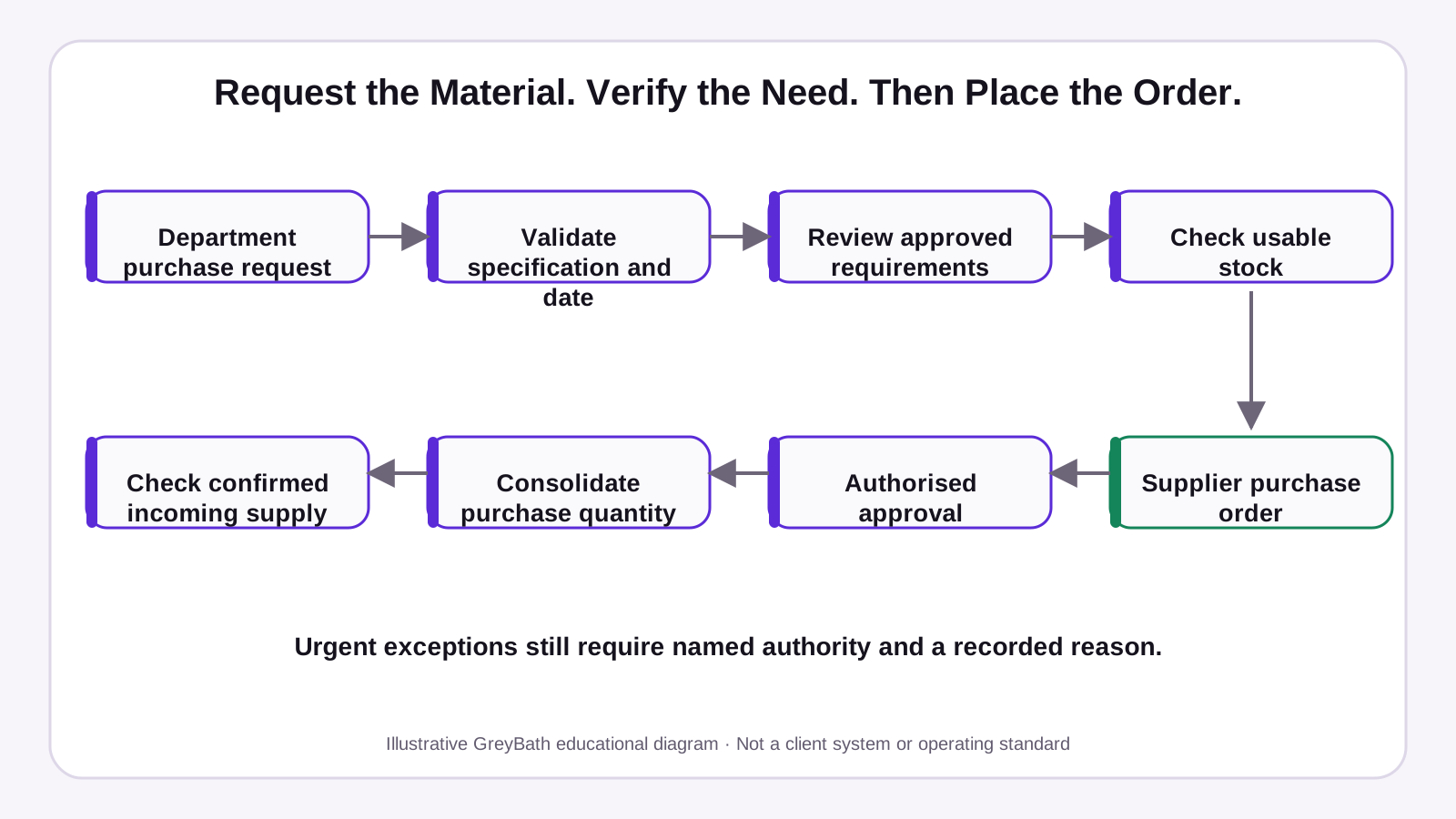
Original GreyBath 2D educational diagram recreated from the owner-supplied visual specification. Figures and examples are illustrative.
A purchase request can be approved without being purchased immediately
Suppose Maintenance requests 50 units of a component for planned work next month.
The department manager approves the requirement.
However, the material is already on order and expected before the planned work.
The purchasing team may decide:
Requirement approved. No additional supplier order currently needed.
This is a valid outcome.
The request should remain visible as a legitimate requirement.
Its status can reflect that the need is expected to be fulfilled from an existing purchase commitment.
This is more accurate than either deleting the request or issuing another order merely because it was approved.
Useful internal request statuses
A small business might use:
Submitted
Under review
Approved
Being consolidated
Covered by existing stock or purchase commitment
Additional purchase required
Converted or linked to purchase order
Fulfilled
Cancelled
The exact status model should follow the business.
Avoid adding unnecessary stages simply because the software allows them.
The goal is for each request to have a clear purchasing outcome.
Do not rely on a spreadsheet that nobody owns
A shared spreadsheet may be sufficient for a company with one factory and a manageable number of purchasing requests.
But it needs basic controls.
The business should define who can add requests, who can approve them, who can change purchasing outcomes and who updates the linked purchase-order references.
If everyone independently edits the quantity and status fields, the register can become unreliable.
Maintain one authoritative purchasing record
The existing ERP or accounting system should remain the recognised source for actual purchase orders wherever possible.
A separate spreadsheet may collect internal requests.
It should not independently become the financial or purchasing master.
For example, if Procurement issues a purchase order in the ERP, the request register should refer to that ERP order.
Do not allow two different systems to create supplier commitments independently without a controlled process.
Watch for delayed updates
Suppose two buyers review the same open request.
Both see that purchasing is required.
Both create supplier orders before either updates the register.
The business can still make duplicate purchases.
A shared spreadsheet does not automatically prevent simultaneous action.
For higher-volume purchasing, the workflow may need an assigned buyer, approval status and a mechanism to prevent or flag concurrent processing.
That is a reason to consider a more controlled system—not necessarily a reason to replace the ERP.
Before automating purchasing, check how replenishment is calculated
Many inventory applications already contain replenishment functions.
They may consider stock levels, open sales orders, purchasing lead times and reordering rules.
Odoo 19, for example, documents automatic and manual replenishment rules based on forecast stock.
Its manual approach allows a buyer to review suggested requirements before placing an order.
This can be useful for repeated material purchases.
But automation should not be activated without understanding the inputs.
Consider a system that automatically creates a new purchase order whenever stock falls below a defined minimum.
If another purchasing employee independently places an order outside that process, the company may create overlapping commitments.
The correct solution could be to bring both purchasing activities into the same process.
Automatic replenishment is not automatically better
For stable consumables with reliable data, automatic replenishment may be appropriate.
For expensive, specialised or irregularly used materials, manual review may be more suitable.
A business should consider:
How predictable is demand?
How reliable are stock records?
How consistent are supplier delivery times?
Are minimum order quantities important?
Do different departments compete for the same stock?
Does the company need management approval before ordering?
The correct choice depends on the item and business process.
Purchasing quantity and invoice quantity must remain separate
Preventing unnecessary purchase orders is only one control.
The business also needs to know what happens after the order is placed.
Suppose Procurement legitimately orders 100 units.
The supplier delivers 80.
The supplier submits an invoice for 100.
Accounts should not assume that the entire ordered quantity has been received.
The business needs to reconcile the relevant purchase-order, receiving and invoice information according to its policy and agreement.
Odoo documents three-way matching involving purchase orders, goods receipts and vendor bills.
However, its documentation also describes configuration-dependent behaviour and exceptions that require review.
This is a separate control from preventing duplicate purchases.
Purchase-request consolidation helps prevent unnecessary ordering. Purchase-order and receipt matching helps validate what is received and billed.
One does not replace the other.
Changes to purchase orders need a controlled process
Suppose Procurement issues a purchase order for 100 units.
Production later reduces the requirement to 60.
The purchasing employee changes the ERP quantity to 60.
But the supplier has already started manufacturing or preparing all 100.
Does editing the ERP automatically reduce the supplier's commitment?
No.
The supplier may need to accept a revised order or cancellation.
The business must consider the terms and stage of the purchase.
The purchasing record should therefore distinguish:
Original order
Requested amendment
Internally approved amendment
Supplier-confirmed revised commitment
Actual goods received
These are different events.
A supplier commitment does not necessarily disappear because an internal employee changes a field.
For material changes, preserve the appropriate order history and supporting communication.
Zoho Procurement's current product documentation describes purchase-order amendments and version histories. The specific workflow should still be verified against the software and supplier agreement used by the business.
A purchase register should show commitments, not just completed purchases
Many owners review a monthly purchase report.
The report shows what was billed or received.
But a company may already have significant pending supplier commitments that are not visible in that historical report.
For example, a company could have:
₹5 lakh of material already received
₹3 lakh of confirmed purchase orders awaiting delivery
₹1 lakh of purchase requests awaiting sourcing decisions
These amounts mean different things.
The ₹3 lakh represents existing supplier commitments, subject to their terms.
The ₹1 lakh represents requested purchasing requirements and may not become an additional ₹1 lakh order after consolidation.
A useful procurement view should keep them separate.
Otherwise, management may interpret pending requests as additional requirements even when some are already covered by existing orders.
Measure how much purchasing coordination improves
After introducing a structured request process, track whether it actually reduces unnecessary commitments and confusion.
Do not judge success only by how many forms employees submit.
Potential duplicate requests reviewed
Count requests that overlap with another open requirement or supplier commitment.
Record how many were genuine additional needs and how many were consolidated.
A warning is not automatically a confirmed duplicate.
Unnecessary purchasing quantity avoided
Where the purchasing team establishes that a proposed order was not required, record the quantity and supporting calculation.
For the hypothetical bearing example:
Originally proposed new purchases: 100
Approved new purchase quantity: 30
Additional quantity avoided: 70
This is a documented purchasing difference within the example.
It should not automatically be described as a realised financial saving.
Requests without purchasing outcomes
Track approved requests that have no assigned buyer or documented sourcing decision.
An approved request should not remain indefinitely without an owner.
Purchase-order commitments awaiting confirmation
Identify supplier orders whose delivery or acceptance position is still uncertain.
This helps distinguish a confirmed incoming supply from an assumption.
Unexplained purchasing changes
Track material amendments and cancellations that lack a recorded reason or appropriate approval.
Do not treat all changes as errors.
Legitimate operational requirements change.
The objective is to keep those changes controlled and understandable.
Time required to process legitimate requests
Measure how long the purchasing decision takes.
A process that prevents duplicates but delays urgent production material unnecessarily may need adjustment.
The aim is not maximum paperwork.
It is reliable purchasing decisions at a practical operating speed.
An exception process is essential for urgent material
A factory cannot always wait for a routine purchasing review.
A critical machine may require an urgent replacement component.
A confirmed production requirement may need immediate procurement.
The business should define who can authorise urgent purchasing and what minimum checks must still occur.
For example, an authorised manager may permit an emergency purchase after a rapid stock and pending-order review.
The reason and approval can then be retained in the purchasing record.
Urgency should affect the speed and escalation of the process.
It should not automatically remove the requirement to establish what is being purchased.
For safety-critical situations, appropriate technical and safety procedures must also govern the decision.
A purchasing workflow is not a substitute for equipment or workplace safety controls.
When this process may need a different approach
The example in this article concerns repeat-use materials with identifiable specifications.
Not every purchase can be consolidated this way.
A custom-manufactured part for one customer's project may require a dedicated supplier order.
Two visually similar components may have different certification or quality requirements.
Materials purchased by separate legal entities may require distinct contractual and accounting treatment.
Some suppliers have minimum order quantities or volume-based commercial conditions that justify buying more than the immediate requirement.
Seasonal materials may be purchased in advance for planned demand.
Certain regulated or hazardous goods require additional purchasing, storage and traceability controls.
These situations should not be treated as purchasing mistakes merely because the quantity exceeds immediate consumption.
The company's purchasing policy should explain when planned surplus stock is justified.
The objective is not to minimise every purchase order. It is to ensure that each purchasing commitment has a documented business reason.
When a connected purchasing workflow becomes worthwhile
A controlled register may work for a small company with limited purchase volume.
A configured ERP may be sufficient when the required purchase-request, approval and inventory functions already exist.
A more connected application becomes relevant when information is divided across departments or systems.
For example:
Production: Maintains material requirements.
Maintenance: Raises equipment-related requests.
Stores: Maintains stock and receipt information.
Procurement: Creates supplier orders.
Accounts: Records vendor bills and payments.
Management: Requires visibility into pending requests and purchasing commitments.
A connected workflow could bring the relevant information into one controlled process.
Before developing it, establish which application is authoritative for each record.
Purchase orders should not be independently created in several systems without clear responsibility.
The technical design must also account for item codes, units of measurement, locations, permissions, approval history and synchronisation failures.
A dashboard is useful only when the information behind it is reliable.
The management decision
When two departments request the same material, the purchasing team should not automatically treat either request as unnecessary.
Both departments may have legitimate needs.
The business must determine the combined requirement.
Then compare that requirement with existing usable stock, confirmed incoming purchases and delivery timing.
Only the remaining quantity should become a new purchasing commitment, subject to appropriate commercial and operational decisions.
For an SME owner, the important question is:
Before we issue another purchase order, can we clearly see what the company already has, what it has already ordered and what departments still require?
Start with a controlled request process.
Give each material a dependable identity.
Review pending supplier commitments.
Assign purchasing responsibility.
Preserve approvals and changes.
Use existing ERP features wherever they are suitable.
Then consider automation when manual coordination becomes difficult.
The objective is not to stop employees from requesting material. It is to stop the company from purchasing more than it has a justified reason to buy.
Where GreyBath can contribute
GreyBath develops custom web applications, ERP/CRM workflows, dashboards, role-based systems and integrations.
For manufacturers, distributors and trading businesses, a potential GreyBath implementation could connect departmental material requests with existing stock, pending purchase orders and approval responsibilities.
Depending on the company's current systems, this could include a purchase-request portal, duplicate-request warnings, purchasing approval workflows, consolidated requirement views and management dashboards.
Where supported interfaces exist, GreyBath could assess integration with an existing ERP or inventory application rather than replacing it.
The implementation would require confirmation of item-master accuracy, supported APIs or authorised exports, access permissions, approval rules and integration feasibility.
GreyBath would not independently decide whether two technical materials are interchangeable or replace the company's authorised purchasing decisions.
For a smaller business, a controlled spreadsheet or configured ERP module may be sufficient.
GreyBath's contribution becomes relevant when multiple departments need one dependable purchasing workflow and maintaining that coordination manually is no longer practical.
Related GreyBath context: ERP, CRM, portals and dashboards and web applications and integrations.
Sources reviewed
These sources support the documented product behaviour and operating concepts discussed above. They do not validate the fictional examples or guarantee a particular result.
- Zoho ERP — understanding purchase requests
- Zoho ERP — purchase-order operations
- Zoho ERP — purchase-order approvals
- Odoo 19 — replenishment
- Odoo 19 — replenishment report
- Odoo 19 — purchase-order management
- Microsoft — 2026 requisition worksheet approvals (dated release note)
- Google Search Central — helpful content
Keep reading
More practical thinking from GreyBath across design, engineering and growth.
All articles